Dallas and Baltimore both leak touchdowns on the ground and through the air, which makes McCaffrey, Hampton and Kittle this week's strongest anytime scoring options.

Touchdown bets usually come down to one question: where does the defense leak? This week, two of my three plays point at the same weakness. Dallas and Baltimore both give up rushing scores, and the Dallas secondary and linebackers also surrender plenty of throws near the end zone. That's worth pulling apart. A defense that's bad everywhere is a different problem from one that's bad only in the compressed space near the goal line, where field width shrinks and the margin for error disappears.
Christian McCaffrey: the goal line is his
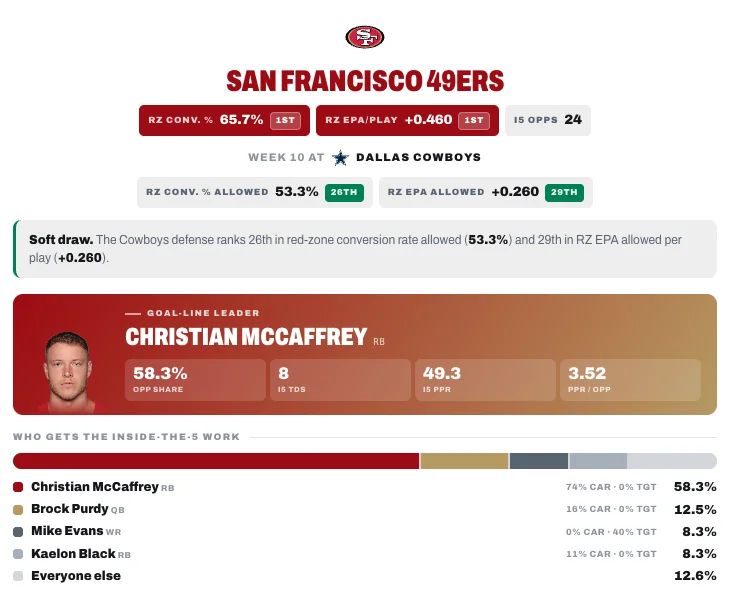
McCaffrey has nine rushing touchdowns through nine weeks, tied for second among 79 rushers with at least 20 attempts. He also has a receiving score, and a long track record of finding the end zone as a pass-catcher. The rushing numbers do most of the work, though. He's taken 14 of San Francisco's 19 carries inside the 5-yard line and scored on eight of them. That's a workload that doesn't depend much on luck.
Here's the thing about goal-line work: it's sticky. Coaches don't hand the ball to a back inside the 5 on a hunch. They do it because the staff has seen which runner converts, and they keep calling his number until the results say otherwise. Rushing touchdowns are a noisy stat over short stretches, since a good back can go a month without one while moving the chains well. Eight scores on 14 carries from that range is the kind of rate that's harder to dismiss as randomness than a raw season total.
The offense is the other half of the case. The 49ers rank first in red-zone EPA per play and red-zone conversion rate, so they keep reaching the spots where McCaffrey gets his chances. Red-zone efficiency is one of the more reliable offensive signals because it measures what happens once drives are already compressed. A team that finishes there isn't just getting close, and that's the part I trust more than any single player's stat line. (And this is the part most people overlook: a strong red-zone unit can make an ordinary runner look like a touchdown machine, so the offense deserves as much scrutiny as the player.)
Now he faces a Cowboys run defense that has allowed 11 rushing touchdowns, tied for the fourth most in the NFL, and ranks 31st in rushing EPA allowed. Rushing EPA is a blunt measure of how much a defense gives up on each run, and a 31st-place ranking puts Dallas near the bottom of the league on it. The 56-point game total matters too. It signals that the market expects plenty of scoring, and it isn't a number you can ignore when you're thinking about touchdowns. That said, a leaky run defense doesn't guarantee a rushing score. Defenses can be generous across a season and still stop a back at the one-yard line on a given afternoon.
Omarion Hampton: thin totals, soft matchup
Hampton's touchdown count looks underwhelming. He has three on 102 carries, and the Chargers have struggled to reach the red zone all season, which caps his opportunities. The role near the goal line is still there, though. He's carried four times inside the 5-yard line and scored on two of them. That's a small sample, but it's a real role.
Three scores on 102 carries is a low rate, and it's easy to read that as a back who can't finish. But the red-zone problem is largely an offensive problem, not necessarily a Hampton problem. A running back can only score as often as his team reaches the area where scoring is possible. When a team struggles to get there, its runners will look worse than they are, and the touchdown column will tell you more about the drives than the player. I'd be wary of judging Hampton by a number that depends so heavily on his teammates.
Baltimore has allowed 12 rushing touchdowns, tied for the second most in the NFL, and its run defense sits in the bottom half of the league in most metrics. That's the kind of matchup that can make a limited back productive, because a bad run defense turns modest opportunities into scores. It won't turn a team that can't reach the red zone into a scoring machine, though. Those are two separate problems, and the bet depends on the first one being solved.
Here's the thing: the bet only works if Los Angeles gets into scoring range with some regularity. If it does, Hampton is the one who finishes. My read is that this is sharper than his season totals suggest, but it still depends on the Chargers' offense getting there. If you're working through this kind of spot, the simplest question is whether the team has been moving the ball inside the 20 recently, not whether the running back has been scoring. Those answers don't always match.
George Kittle: a receiving option with real volume
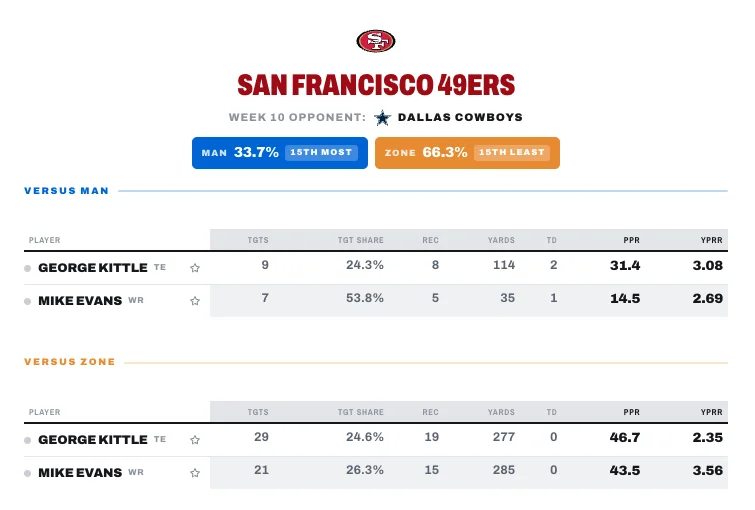
Kittle has five receiving touchdowns this season, tied for ninth among 161 pass-catchers with at least 20 targets. He's also drawn 12 red-zone targets, tied for eighth in the NFL, and has scored on four of them. That's a role that produces touchdowns, not just looks.
Targets in the red zone are a better indicator than total receptions, because they show where the offense is actually designing plays for a player. A tight end who gets looks near the goal line has been trusted by the play-caller in exactly the situations that matter. Four scores on 12 targets is a strong conversion rate by any reasonable standard, and it suggests Kittle is finishing the chances he's given. The volume is the part I'd bet on holding, while the conversion rate is more likely to regress toward normal over time.
Dallas has allowed 16 passing touchdowns, tied for the fourth most in the league, and it plays zone coverage at a high rate. That's where Kittle has been productive. He's averaged 2.35 yards per route run against zone and earned a 77.6 PFF receiving grade on those snaps. Zone-heavy defenses leave soft spots near the end zone, because defenders are watching space instead of tracking a specific receiver, and Kittle knows how to find those gaps. A zone-based defense that gives up 16 passing scores has a problem, and this matchup is where it shows up.
This is a game script and a defense worth attacking. With the 49ers' red-zone efficiency, there should be enough touchdowns to go around. The number to watch is how often San Francisco reaches the 5-yard line, because that's where all three of these bets get cashed. If the offense stalls at the 20 and settles for field goals, none of the touchdown logic matters, and that's the scenario I'd keep in the back of my mind.
What this means if you're following these matchups
Touchdown props are a narrow kind of bet, and they reward people who understand the mechanics behind the stat line. The common mistake is treating a player's touchdown total as a measure of his talent. In reality, scores depend heavily on the team's ability to reach the red zone, the play-caller's tendencies, and the defense's performance in a few compressed snaps. Those factors shift from week to week, which is why a player who looks cold in September can look hot by November without changing much at all.
What this means for you depends on how you read the data. If you're looking at these three plays as a single bet on Dallas and Baltimore's weaknesses, you're leaning on one thesis that could fail in several ways. The offense might stall. The defense might hold near the goal line. A single bad drive can erase a lot of good analysis. That's not a reason to ignore the matchups, but it is a reason to be honest about how much of the outcome sits outside the numbers.
The bigger question is how much these stats really tell you. Red-zone metrics are more stable than raw touchdown totals, and they're worth tracking across a season. Still, the sample sizes here are small, and a few goal-line carries or targets can swing a player's line considerably. The analysis is most useful when it sharpens your read on a matchup, and least useful when it's treated as a guarantee. That's the part of the article I'd keep front and center.
Discussion
Sign in to join the discussion.