Coverage tendencies point to Omar Cooper Jr. against Buffalo, a Seahawks rushing day against Las Vegas, and Jalen Coker in a Panthers passing game against New Orleans.

Coverage tendencies drive this week's same-game parlay ideas, and three of them look stronger than the odds suggest. Here's the thing: a parlay is only as good as its weakest assumption, and each of these builds rests on a matchup read rather than a sure thing. Jets rookie Omar Cooper Jr. has the clearest path, but Seattle's backfield and Carolina's passing game have matchups that deserve a closer look. (And this is the part most people overlook: a same-game build ties every leg to one game script, so one bad stretch can sink all of them at once.)
Cooper finds room against Buffalo's single-high looks
No team has played more single coverage over the last month than the Bills, who have done so on about 56% of their snaps. That's a lot of man-on-man exposure, and it's where Cooper can do damage. Man coverage isolates a receiver against one defender, which is why it shows up so often in film-based breakdowns of pass game efficiency. The real question is whether the matchup causes the problem or just reflects how Buffalo chooses to play, and I'd argue the scheme is a big part of it.
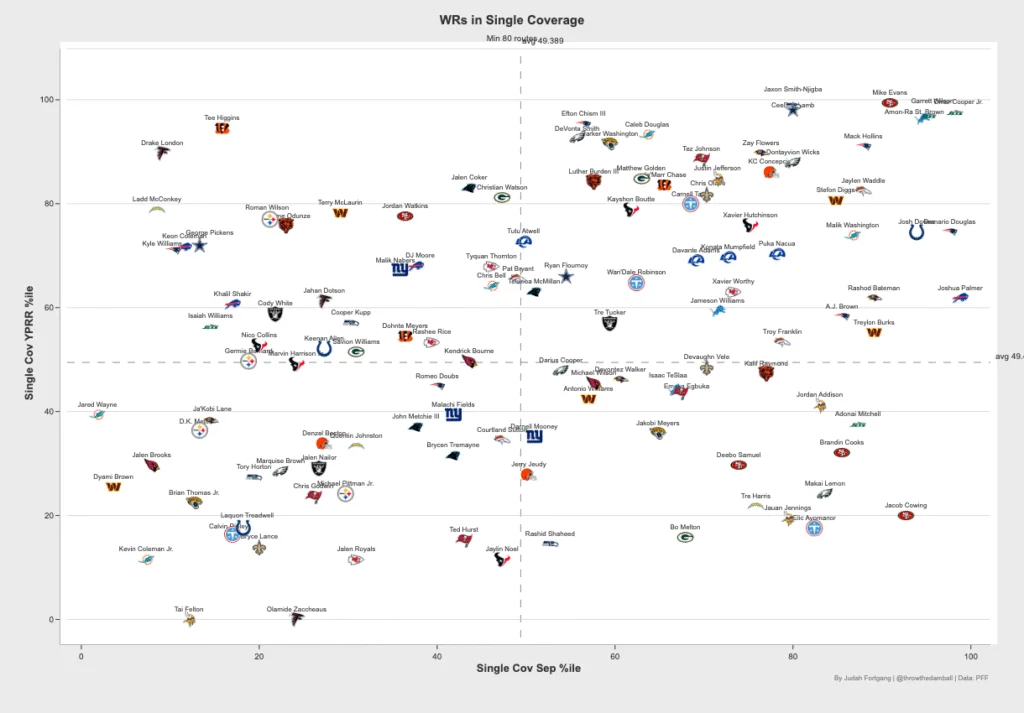
Several Jets receivers have handled single coverage well, but Cooper stands out. He sits in the 98th percentile in both separation and yards per route run against that look, and he earns a target on nearly one of every four routes against it. Those are the numbers that matter more than raw totals, because they show how a player performs when he's asked to win a one-on-one rep. Per-route rates are a cleaner signal than season volume, which can get distorted by a couple of blowout games. Still, a percentile is relative to its sample, and that sample deserves a hard look before you lean on it.
The slot is where Buffalo has struggled. Opponents attack Bills slot defenders at the fifth-highest rate in the league, and Buffalo has allowed the second-most explosive plays from the slot. Add an offense that should have little trouble scoring against New York, and the volume should follow for both Cooper and the Jets' passing game. That said, volume only helps if the ball goes his way, and an offense leaning on short, efficient throws may not produce the big plays this build needs.
SGP build: 35-1
- WR Omar Cooper Jr., New York Jets: 6 receptions + 100 yards + TD
Taken together, the Cooper build depends on two things going right at once: single coverage showing up and Buffalo's slot defense getting beaten. Neither is guaranteed. The 35-1 price reflects that uncertainty, and it's the reason a build like this reads better as a thesis than a lock. Anyone tracking it should watch whether Buffalo's coverage mix holds through the week.
Seattle's ground game meets a leaky Las Vegas front
The Seahawks are dealing with a quarterback mess, with Sam Darnold out and Drew Lock banged up. Last week, Seattle leaned hard on the run, calling it about 10% more often than expected once game situation was factored in. Lock didn't attempt a single pass traveling more than 17 yards downfield, and that isn't exactly a sign of a healthy passing game. When the quarterback room thins out, coaches often lean on the ground game to protect a limited passer. It's a sensible call, but it also says plenty about where the passing game stands right now.
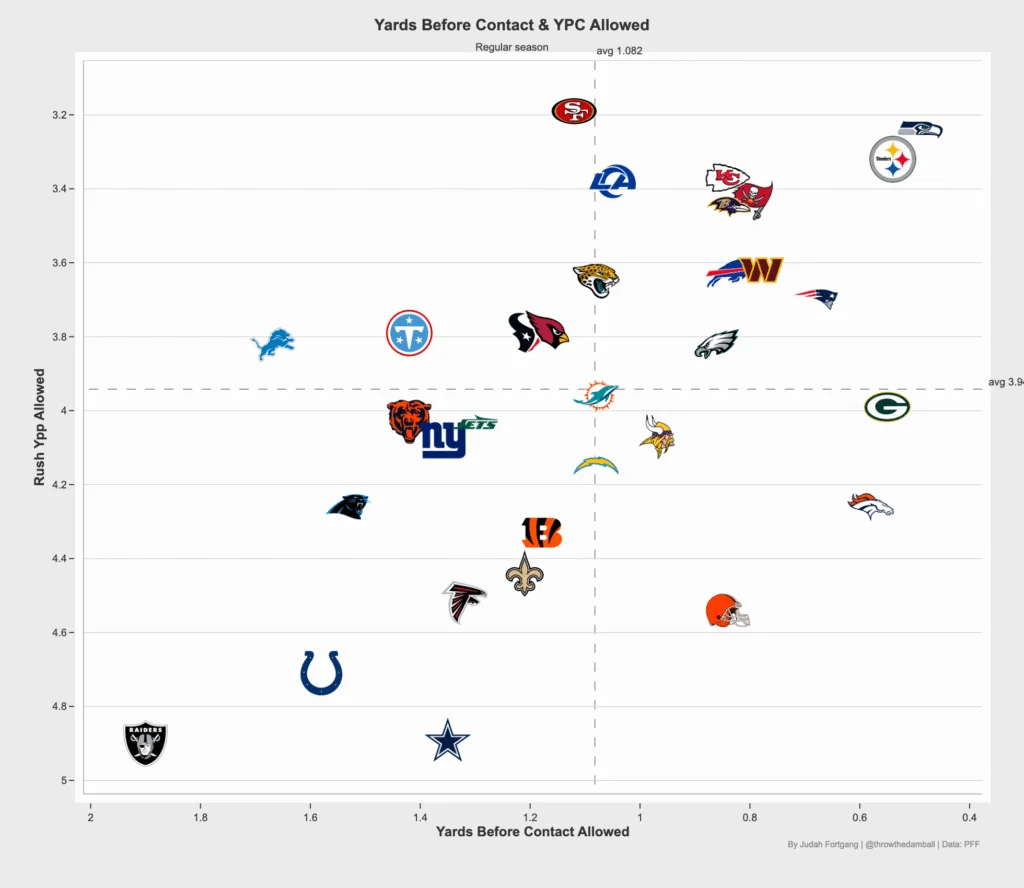
Las Vegas is the right opponent for that approach. The Raiders allow by far the most yards before contact in the NFL, and they surrender the most yards per carry of any run defense in the league. Yards before contact measure how much room the offensive line creates, which depends heavily on how well the front seven penetrates and holds its gaps. A defense that gives up ground before defenders arrive tends to get run on repeatedly, and that kind of weakness doesn't fix itself in a single week.
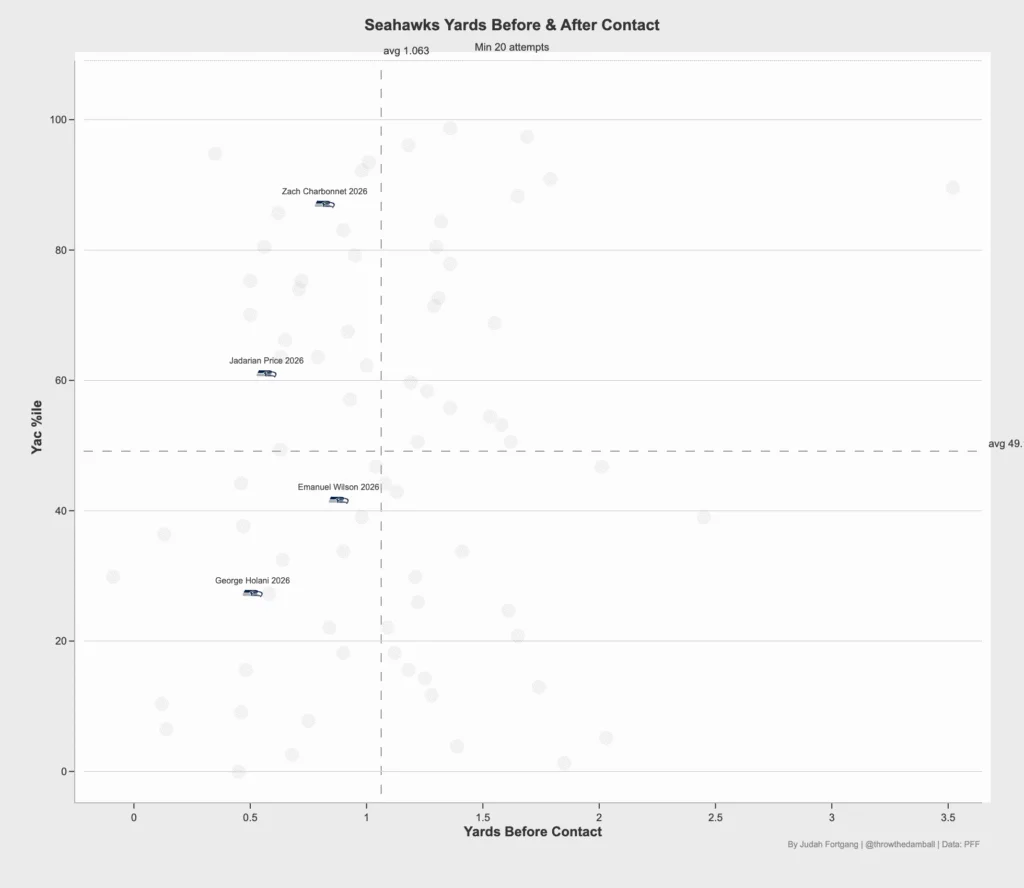
Seattle's backs have struggled to find room at the line, but Zach Charbonnet and Jadarian Price have been solid after contact. This matchup should open space before contact. On the other side of the ball, rookie Fernando Mendoza makes his first start against what may be the league's best defense. That points to short Raiders drives, which means more possessions and more snaps for Seattle's backfield. If the Raiders' offense stalls early, the run game gets more chances to do its job, and that's the whole logic of this build.
Charbonnet should see the bulk of the work at roughly a 70-30 split. Price still figures to get plenty of touches, and his more explosive profile gives him a real chance to add yards on his own. The split matters because it decides which leg has the higher ceiling and which one depends on a lucky break. A committee backfield can produce two solid stat lines, or one great one and one dud, and that variance is the part skeptics tend to flag. Price's upside is real, but he's also the leg most likely to swing on a single long run.
SGP build: 45-1
- RB Zach Charbonnet, Seattle Seahawks: 100+ rush yards & TD
- RB Jadarian Price, Seattle Seahawks: 80+ rush yards
Coker's coverage fit against New Orleans
The most direct way to build on the Panthers angle is to lean into the passing game, specifically Jalen Coker. His skill set lines up well with how the Saints defend, and his price makes him an appealing option to lead Carolina's passing attack. Here's the thing, though: a price only means something if the matchup read holds up, so the numbers below have to carry the argument. The Saints' coverage data is the strongest part of this case, and it's where I'd focus your attention.
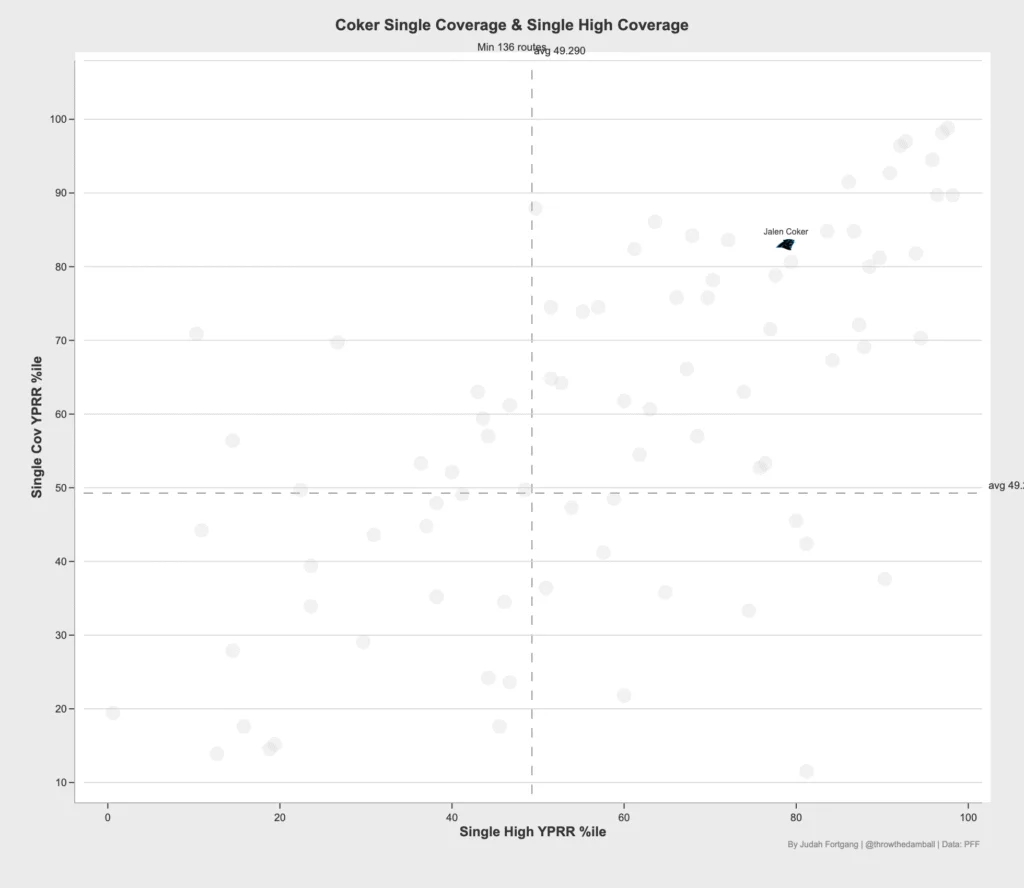
New Orleans plays both single coverage and single-high safety looks at top-five rates in the NFL. Coker ranks above the 80th percentile in yards per route run against both, and he leads the Panthers in targets against each. He also commands a target share just north of a quarter against single coverage. That's a receiver who gets targeted on the looks he handles well, which is exactly what you want from a passing-game piece. Single-high safety looks are typically designed to take away deep shots, so a receiver who's productive against them is usually winning underneath or in the intermediate areas.
With Carolina's passing game in a favorable spot, I like a same-game parlay built around a Bryce Young-to-Coker connection, paired with a Panthers win. That's the stance of this piece, and I'll own it. Parlays compound risk, though, so every added leg has to be earned rather than assumed. The Panthers at -2.5 and the 275-yard passing line both depend on Young moving the offense efficiently, and that's the dependency to watch.
SGP build: approx. 30-1
- QB Bryce Young, Carolina Panthers: 275+ passing yards
- WR Jalen Coker, Carolina Panthers: 100+ receiving yards
- Carolina Panthers: -2.5
What these three builds tell you
Step back and the three builds share a common thread: each one bets on a matchup weakness rather than a team's general quality. That's a useful way to think about the slate, but it's also where the risk hides. Single coverage tendencies, slot vulnerability, and run defense before contact are all patterns, and patterns can shift when a coordinator adjusts. This is more significant than it looks, because the strongest case here rests on how each defense has performed in specific situations, not on the teams' records.
What this means for you depends on how you're approaching the slate. If you're building your own parlays, separate the legs you've actually checked from the ones you've simply assumed. Correlated legs can feel safer than they are, since one game script can help or hurt several bets at once. Watch the Seahawks' quarterback situation in particular, because it shapes both the run-heavy plan and any passing props tied to it.
Looking ahead, these ideas will hold up or fall apart once the injury reports and game plans settle. Percentile rankings and yards per route run tend to stabilize over larger samples, so a single week of data is thin. And yet the underlying logic, that scheme-driven weaknesses tend to repeat, is worth tracking beyond this slate. Expect the next round of coverage data to either confirm these tendencies or expose them as noise.
Discussion
Sign in to join the discussion.