Detroit's trouble with explosive plays meets Drake Maye's deep passing, while San Francisco's perfect-block edge puts pressure on a Cowboys defense that struggles when linemen execute.

Patriots' deep game meets a Lions defense that leaks big plays
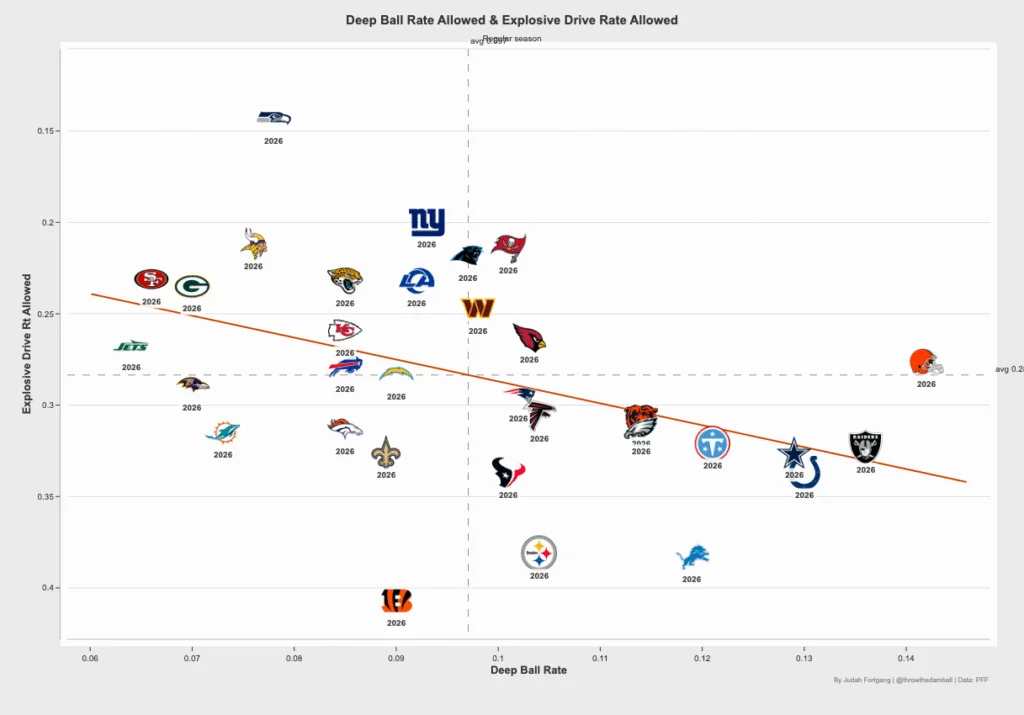
Detroit's defense has a clear weak spot for this matchup, and it isn't subtle. The Lions rank second-worst in the NFL in explosive play rate allowed per drive, and nearly 40% of opposing drives have produced at least one explosive gain. That's a lot of drives ending with a receiver or runner in open grass. Most of the damage has come through the air, where Detroit sits among the bottom five in explosive pass-play rate allowed. (And this is the part most people overlook: giving up chunk pass plays usually isn't a single-player problem. Coverage shells, pass rush timing, and safety depth all feed into it, so a leaky secondary often reflects decisions made before the snap.)
PFF's 2022 study on explosive plays showed how much those chunk gains drive offensive success, and this matchup puts that idea to the test. Explosive plays are the rare events that flip a drive's math. A short gain keeps the chains moving, but a long one changes field position, forces the defense to rethink its calls, and can end a possession with points before the opponent gets set. Detroit also faces a high volume of deep pass attempts, which gives its opponent more chances to win on the big play. Here's the thing: volume matters as much as quality. Every deep attempt is a bit like a lottery ticket, and the more tickets an offense gets, the better its odds of cashing one.
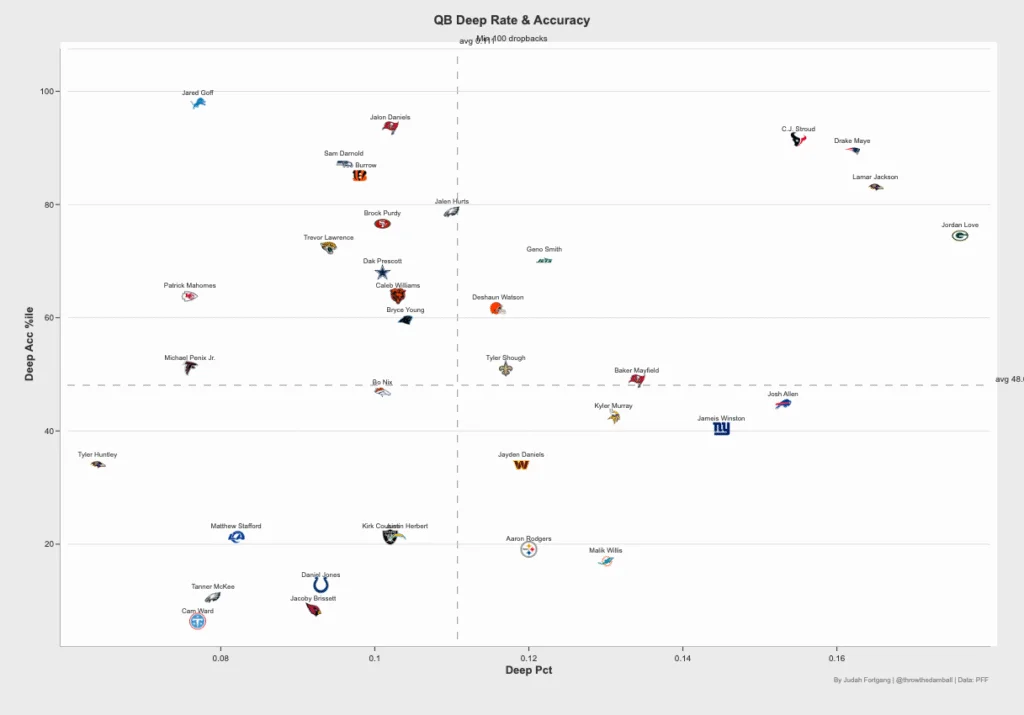
That's where Drake Maye comes in. He throws deep at the third-highest rate in the NFL and ranks among the league's most accurate deep passers. If you're tracking quarterbacks, separate deep attempt volume from deep accuracy, because a quarterback can chase big plays all day without hitting them. Maye's profile combines both, which is less common than it sounds. It's no surprise the Patriots rank third in explosive play rate.
This is an offense built to generate the chunk gains that sustain drives and turn them into points. Its passing game doesn't just move the chains; it creates the kind of scoring opportunities that stack up quickly. Detroit should move the ball too, and the question is whether its offense can keep pace in a shootout. If New England connects on explosive plays with any regularity, though, the game pace could speed up and open plenty of scoring chances. That's the scenario that makes the total interesting here.
The clearest read from this data points toward the game total and same-game parlay ideas built around a Patriots win driven by the passing attack. I'd still be cautious about treating any single matchup stat as a guarantee. Explosive play rates are noisy over small samples, and one busted coverage can swing a game more than a season-long trend suggests.
Brock Purdy and the 49ers' line set up a strong test for Dallas
Offensive lines behave like a weak-link system. One lineman missing his assignment can let pressure in and wreck an entire play, even when the other four do their jobs well. That's why line grades based on individual reps can hide what actually happens in the pocket. Perfect blocks measure the outcome directly by asking one question: did everyone on the line do his job?
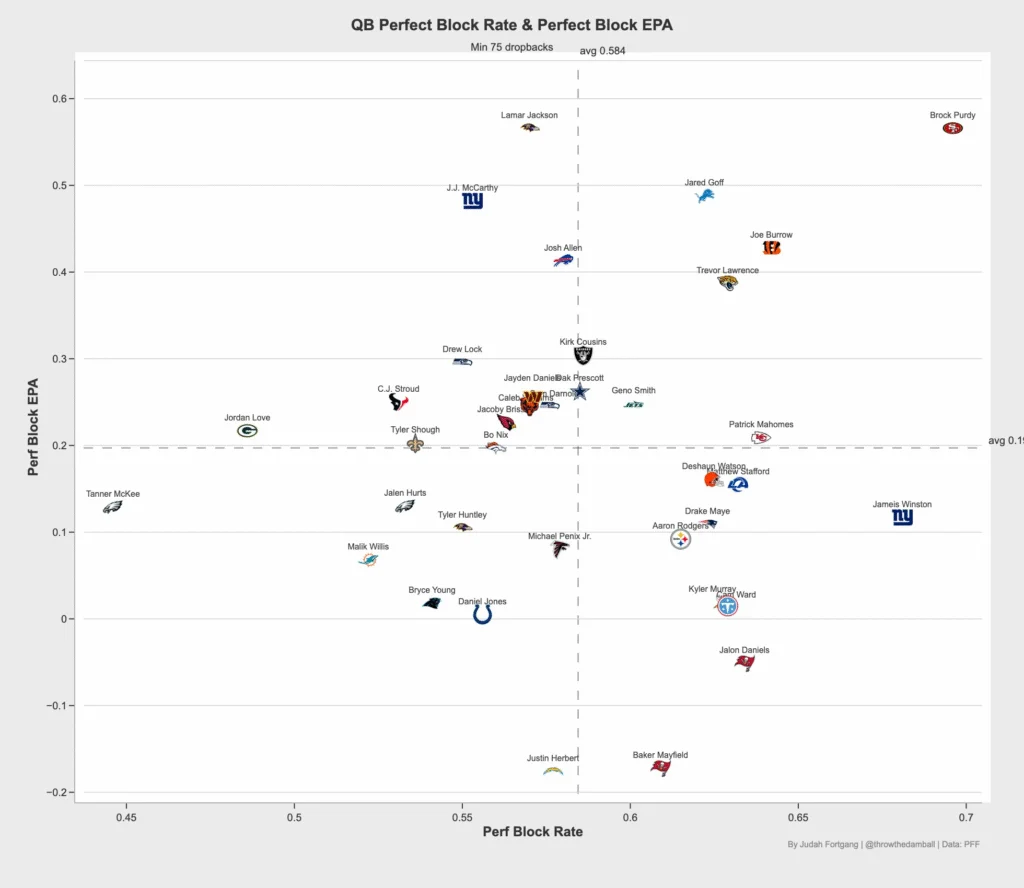
The gap is large, and it shows up in the efficiency numbers. The average offense generates nearly 0.2 expected points per dropback on perfectly blocked plays, and that number separates clean pockets from broken ones. Think of it as the difference between a quarterback with time to read the field and one forced to throw off his back foot.
San Francisco leads the NFL in perfect-block rate, and Purdy and the offense are nearly four times as productive on those plays. Few teams pair that volume with that efficiency, and that's what makes the 49ers unusual. Here's the thing: it's not just about how often the line executes. It's about how much the offense does with the time it gets. A line that protects well but doesn't give its skill players room to work only gets you so far.
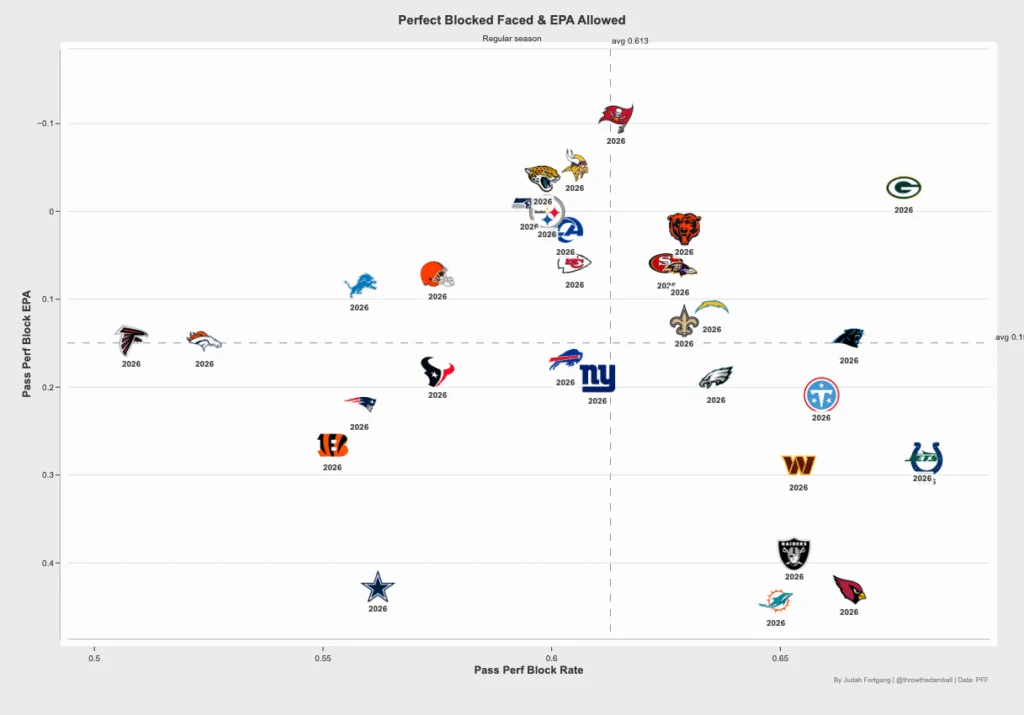
Dallas has been good at forcing blocking mistakes, but its defense gets eviscerated when the opposing line holds up. The Cowboys have faced perfect blocks on roughly 57% of dropbacks and allowed nearly 0.45 expected points per play in those situations. That's a stark jump, and it suggests the Dallas defense depends heavily on opponents breaking down. Against a line that doesn't break down, the margin for error disappears.
San Francisco hasn't posted a perfect-block rate below 60% in any game this season. That consistency is the real story, more than any single strong week. It suggests Purdy should get a clean pocket often enough to exploit that Dallas weakness, and that's a reasonable read rather than a certainty. The 49ers offense looks like the more reliable side of this matchup, and the market angles here are 49ers spreads, team total overs against Dallas, and same-game parlays built on San Francisco's passing efficiency.
What this matchup says about the bigger picture
Put the two games side by side and a pattern emerges. Both matchups turn on whether an offense can convert favorable conditions into repeatable advantages. In Detroit's case, that means exploiting a defense that concedes big plays. In Dallas's case, it means punishing a defense that depends on mistakes up front.
For readers who analyze games for a living, the lesson is about metric pairing. Explosive play rates tell you what happened downfield, while perfect-block rates tell you why the quarterback had time to find it. Used alone, either one can mislead. Used together, they show whether a team's production is built on structure or on a few lucky sequences.
If you're working in this space, the practical takeaway is simple. Check whether a team's strength depends on opponents' weaknesses, and check whether those weaknesses are structural or just a bad stretch. That's the question that separates a well-supported read from a hot take, and it's the one worth asking before you trust any number on its own.
Discussion
Sign in to join the discussion.