Offense surged across the minors this year, and with a lockout looming, teams face harder calls on prospects whose numbers may not mean what they appear.
Teams are heading into an offseason already loaded with uncertainty: a looming lockout and a thin free-agent class. Expect some moves that look baffling from the outside. Most won't be irrational. They'll be front offices trying to act sensibly in a market that's getting harder to read by the week.
If you're watching this from the outside, start with the free-agent class. When the pool of available talent shrinks, clubs stop shopping for the best option and start shopping for the least bad one. That's where many of the odd-looking deals come from. A team that seems to overpay for a mid-tier player may really be choosing between that player and nothing at all. A labor fight adds a second layer, and it's the part that makes planning feel like guesswork. Rosters get built without anyone fully knowing the rules they'll be working under, which pushes everyone toward hedged, short-term thinking.
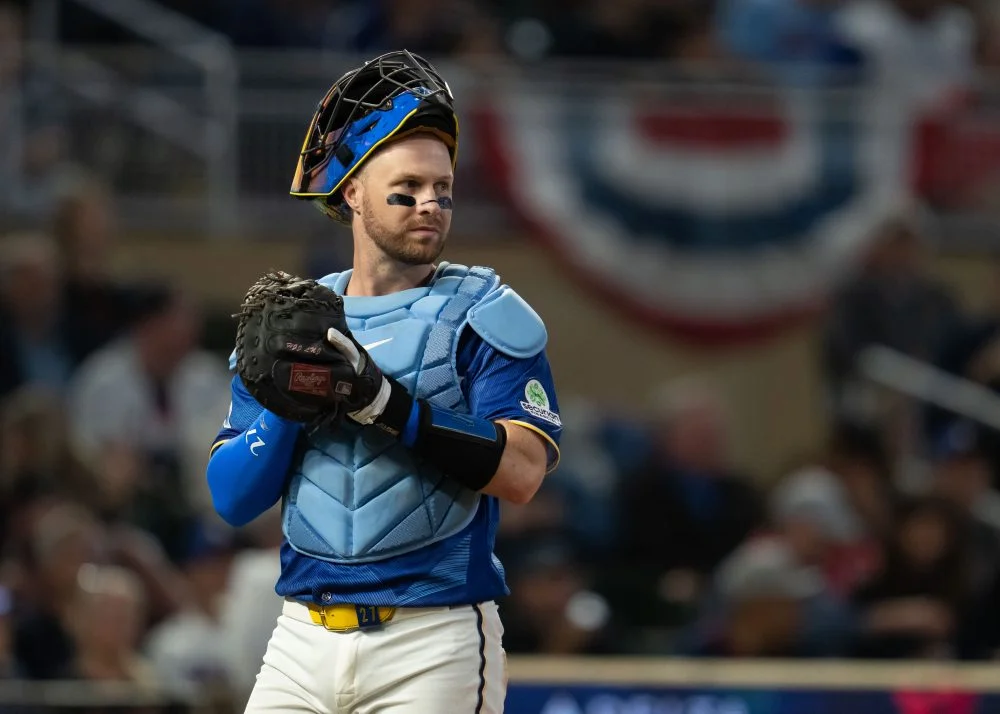
Image credit: IMAGN IMAGES via Reuters Connect
The numbers are tilted
There's another layer of noise, and it has nothing to do with who's available. Run scoring across the minor leagues swung hard toward offense this season, which makes it tough to pull real signal from a player's results. A gaudy line might reflect talent. It might also reflect a hitter-friendly park and a ball that's carrying.
Here's the thing: minor league stats were always a noisy read, and a sudden shift in run scoring makes that noise louder. Evaluators have long warned about this kind of distortion, which is one reason organizations build internal models rather than trusting raw totals. (And this is the part most people overlook.) The same league-wide swing that inflates one player's line can quietly deflate another's. The damage cuts both ways, and it's easy to miss.
Brewers boss Matt Arnold is working through exactly that problem. His top prospects have posted wildly divergent numbers, including Andrew Fischer's assault on 50 homers, Braylon Payne's power breakout and Bishop Letson's 4.85 ERA. "You try to take into account so many different things in the environment, with the ballpark, the wind, the baseball, the player," Arnold said. He added that a single wall change in right field can alter the wind enough to matter.
That said, the spread Arnold describes is what makes this so hard. A 50-homer season and a 4.85 ERA can both be real, and both can be misleading. Sorting out which parts belong to the player and which belong to the environment is the whole job. It's slower work than most fans realize. Consider the wall detail. A fence change sounds minor, but if it shifts the wind enough to alter how fly balls carry, a hitter's home run total may say more about a construction decision than about his swing.
Stat lines can warp the player, too
Everyone would prefer to grade process. But when the stat lines are skewed, they can skew a player's self-image as well. A hitter who can't look past his own slash line may start chasing the wrong things and drift into bad habits, even if the front office sees through the numbers.
Here's where it gets personal. Players read their own box scores, and a misleading line can change how they swing, how they recover from a bad stretch, and how they talk about their own development. A young hitter who sees a poor slash line caused by a run environment he can't control may still conclude he's the problem. That conclusion can stick longer than any bad week.
Red Sox president of baseball operations Craig Breslow framed the core challenge. "What is really, really difficult to quantify is, what is the emotional impact on the physical performance as a result of confidence being down because of, you know, a changing run environment," he said. Teams still lean on scouts and coaches to fill the gap between what a player's talent suggests and what they actually see.
And yet, the quote points to something harder to measure than a slump. Confidence doesn't show up in a spreadsheet, so it gets treated as noise, even when it may explain a meaningful share of the variance. Clubs that take this seriously tend to rely more on direct conversations with players than on the numbers alone. If you're working in player development, that's the uncomfortable takeaway: a stat you report without context can do more harm than good.
Where that leaves evaluators
Breslow's view is that teams are generally good at chasing the underlying ability behind performance. The hard part is explaining the distance between that ability and the box score. My read: the sharpest decisions this winter will come from clubs that treat a stat line as a hypothesis, not a verdict. Watch which front offices let scouting and coaching reports overrule a gaudy minor league season, and which ones get fooled by it.
This is more significant than it looks. Evaluators have always had to translate performance into ability, but a shifting run environment makes that translation less reliable at the exact moment decisions carry the most weight. The practical risk is overcorrection. Some teams will discount every strong minor league line as park-driven, and that's its own kind of lazy thinking. Dismissing a hot season is no more rigorous than believing it outright.
What this means for the offseason
Put the pieces together and the offseason looks less like one big bet and more like a series of small verdicts. Teams with thin free-agent options will lean harder on internal development, which means their prospect evaluations carry more weight than usual. If those evaluations rest on inflated or deflated stats, the mistakes won't surface in headlines. They'll show up later, in rosters that underperform for reasons nobody can quite name.
Whether this resolves cleanly depends partly on things outside the numbers. Labor uncertainty tends to push clubs toward caution, and caution often means waiting for more information. That said, waiting carries its own cost, especially for teams trying to patch holes. I'm not predicting how the labor situation shakes out. I'm saying the evaluation problem won't disappear with it.
What this means for you: if you follow a team closely, stop treating a single hot minor league season as proof. Ask what the park did, what the wind did, and what the scouts saw. Slow work. Necessary work. You'll learn more from that conversation than from any leaderboard, and you'll be better positioned when the next surprising move lands.
Discussion
Sign in to join the discussion.