Boye Mafe pairs strong pass-rush production with elite run defense, while Dexter Lawrence’s presence has helped reduce the attention he faces.

A broader defensive makeover
Cincinnati’s offseason defensive makeover is paying off in more ways than one. Dexter Lawrence has drawn attention inside, while edge defender Boye Mafe has delivered a balanced start that helps explain why the Bengals’ defense has gained more than a simple replacement for Trey Hendrickson. The distinction matters: replacing a star’s production is difficult, but a defense can also change how that production is distributed across the front. Mafe’s early results suggest Cincinnati’s gains include a different mix of pass rush and run defense.
That’s a useful way to judge the move. An edge defender’s value isn’t captured by sacks alone, and the figures here point to a player contributing in phases that can complement the pressure generated by teammates. They don’t establish that Mafe has matched Hendrickson’s peak. They do show why a direct comparison of headline pass-rush totals would miss part of the story.
Pass rush: strong, but below Hendrickson’s peak
Mafe’s pass rush hasn’t matched Hendrickson’s best Cincinnati season, but the gap is manageable. Through the first 10 weeks, Mafe has generated 43 pressures, seventh among edge defenders, and earned an 82.7 PFF pass-rush grade, sixth at the position. Those rankings put him among the leading edge defenders in the figures provided, even if they don’t make him the most productive rusher in the comparison.
Hendrickson’s 2024 campaign set a higher bar: a 90.4 grade, fourth among edge defenders, and 83 pressures, tied for the league lead. That is a substantial benchmark, and Mafe’s 43 pressures show that Cincinnati hasn’t simply reproduced Hendrickson’s peak production. But a comparison with a league-leading season can make a productive start look smaller than it is. The more useful question is how Mafe’s output fits with the rest of the defense, and whether he’s adding value in areas Hendrickson’s profile didn’t emphasize to the same degree.
Run defense is Mafe’s clearest advantage
The more striking difference is what Mafe contributes against the run. He has a 74.8 PFF run-defense grade this season, ranking 12th among edge defenders. Hendrickson posted a run-defense grade above 65.0 only once during his 2021–2025 Cincinnati tenure: a 65.9 mark in 2024, which ranked 50th. The separation in these grades gives Cincinnati a different kind of edge production, rather than a like-for-like exchange at the position.
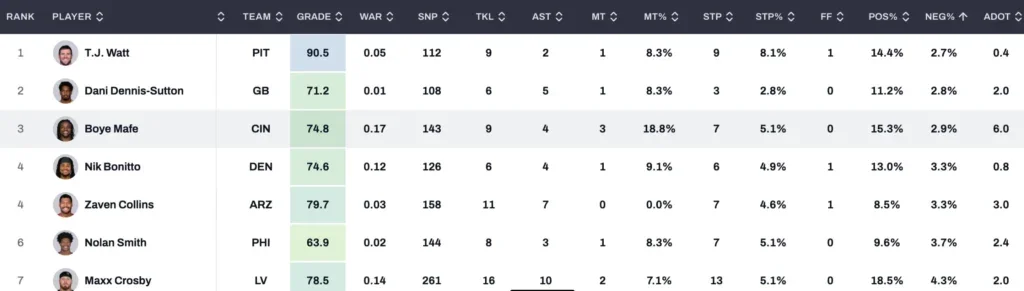
Grades are one way to describe that difference; the underlying rates add useful detail. Mafe’s production isn’t built on a high tackle total. He has seven tackles resulting in a defensive stop, placing 40th among edge defenders. But among players with at least 100 run-defense snaps, his 15.3% positively graded play rate ranks 26th, while his 2.9% negatively graded rate ranks third. He’s making plays at an above-average clip and, more notably, avoiding mistakes at an elite one.
That combination deserves attention. A low negative-play rate doesn’t mean a defender is dominating every snap, and the positive-play ranking shows Mafe isn’t at the top of that measure. Still, limiting costly errors can help a defense keep its shape against the run. This is more significant than it looks: a player who can contribute without repeatedly creating setbacks offers a different kind of value from one whose case rests mostly on splash plays.
Lawrence changes the attention Mafe faces
Lawrence’s arrival has also altered the conditions around Mafe. Opponents have double-teamed Lawrence on 81.4% of his pass-rushing snaps, 12.3 percentage points above the rate for any interior defender on Seattle’s defense in 2025. That focus gives Mafe more chances to attack one-on-one. In pass protection, a double-team directed at one defender can leave another with a less complicated assignment; that’s the basic logic behind viewing Lawrence’s attention as an opportunity for Mafe.
The figures on Mafe’s own double teams are consistent with that explanation. He was double-teamed on 31.1% of his pass-rushing snaps in his final Seattle season. In Cincinnati, that rate has fallen to 23.5%, a drop of 7.6 percentage points. Fewer double teams don’t guarantee more pressures, since a single blocker can still win a matchup, but they help explain why his current opportunities may differ from those he had in Seattle.
The change doesn’t erase the difference between Mafe’s current pass-rush output and Hendrickson’s peak, but it helps put Mafe’s rise in context. The credit is shared: Mafe has to take advantage of the matchups he gets, while Lawrence’s presence appears to influence where opponents direct their protection. A pressure total without that context can tell you what happened, but less about why the conditions changed.
What the early WAR figure says
Mafe’s season-level impact is reflected in his Wins Above Replacement (WAR): 0.17 through 2026, ranking second among 184 edge defenders. His previous best was 0.16 in 2023, when he ranked 28th among 186. He had 0.13 in 2024 and 0.09 in 2025; his 2022 figure was -0.02. The current mark is a personal high in the figures supplied, though WAR is a summary measure and doesn’t tell the whole story of how a player is producing.
That year-by-year record also gives the current start some perspective. Mafe had produced useful WAR figures before, including the 0.16 mark in 2023, so the evidence doesn’t describe an entirely new level of player emerging from nowhere. The noteworthy change is that his current figure has moved above that previous best while his run-defense grade and pressure rankings point to contributions in more than one phase.
The implications for Cincinnati
The Bengals’ headline addition may be Lawrence, but Mafe’s run defense and improved pass-rush opportunities have made the edge position more complete. His start suggests Cincinnati has found a productive new role for him while narrowing the practical cost of losing Hendrickson. That’s a more restrained claim than saying the defense has replaced Hendrickson’s best season, and the numbers support the distinction.
If you’re evaluating Cincinnati’s front, watch how these pieces continue to fit together. Mafe’s pressure production remains below Hendrickson’s 2024 output, while his run-defense profile is a clear point of difference. Lawrence’s double-team rate helps explain Mafe’s lighter treatment, but the figures don’t show how much of the change in team performance comes from that factor alone. And this is the part most people overlook: a defense can gain flexibility even when it hasn’t found a one-for-one replacement.
For now, Mafe’s start gives Cincinnati a credible answer at edge without requiring every part of his game to mirror Hendrickson’s. The pass rush is productive. The run defense is the sharper distinction. The next test is whether that balance holds across the season.
A different profile, with real value.
Discussion
Sign in to join the discussion.