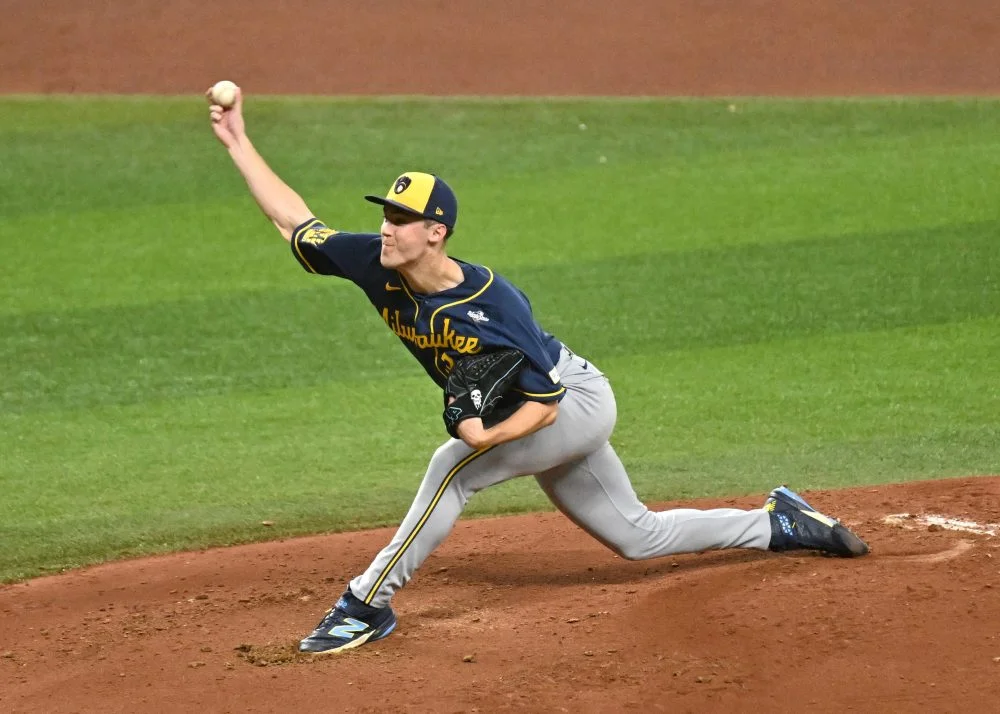
Milwaukee’s success may offer lessons in player development, but the clearest visible model is Jacob Misiorowski’s explosive approach on the mound.
What a successful season can—and can’t—teach
The Milwaukee Brewers’ 2026 success invites plenty of theories: bunting, contact hitting, roster management, managerial skill and the technology behind player development. A winning team gives observers a visible result, then invites them to work backward and explain it. The problem is that several of those explanations can sound plausible at once.
A team’s results rarely reveal which ingredients made the difference. Without access to internal data and decision-making, outside observers can mistake correlation for a blueprint. A tactic that appears alongside success might have helped, or it might simply be the part of the operation that’s easiest to see.
That limits what other clubs can reliably copy. The most useful lessons are the ones visible on the field, where a player’s actions and opponents’ responses can be examined directly. Jacob Misiorowski offers one of the clearest examples. His approach suggests that teams can look beyond raw velocity when searching for pitchers who unsettle hitters.
Misiorowski’s advantage is more than velocity
Plenty of major-league pitchers reach 100 miles per hour. Few attack the plate with Misiorowski’s combination of speed and forward drive. His explosiveness carries him down the mound, cutting the distance to the hitter while the ball is still in his hand.
That movement changes the experience at the plate. Hitters must adjust not only to a fast pitch but also to the pace of the delivery and how quickly the ball seems to arrive. Misiorowski’s velocity matters, but it’s only part of the effect.
For a hitter, a pitch’s arrival is the end of a sequence that begins with the delivery. The pitcher’s movement helps set the timing and gives the batter less time to settle into a familiar rhythm. That doesn’t make forward momentum a substitute for command or speed; it makes the delivery part of the problem a hitter has to solve.
This distinction offers a practical point for player development. Clubs may not be able to produce another Misiorowski, and his exact combination of traits may be rare. But there may be pitchers who can adopt some version of his approach. The search could focus on how a pitcher moves toward the plate, as well as how hard he throws.
That’s a more useful question than simply asking which pitcher throws hardest. If you’re working in this space, you’d want to know whether a player’s mechanics can create a similar challenge without disrupting the parts of his delivery that already work. The answer will vary by pitcher.
Visible results can make poor templates
Baseball teams study successful organizations, but a winning season doesn’t come with a clear instruction manual. A club might attribute Milwaukee’s results to bunting or contact hitting when the deeper causes involve personnel, coaching, preparation or tools that outsiders can’t see. Several factors may also interact, making it difficult to isolate the contribution of any one choice.
That’s why broad claims about the Brewers risk producing the wrong takeaways. A tactic that appears central from the stands may be incidental, while a less visible part of the operation may matter far more. Replicating the surface can’t guarantee replicating the outcome.
Even a tactic that works for one roster can travel poorly to another. Players have different strengths, and a team’s choices are made within the limits of the people it has. A copy can preserve the visible action while losing the conditions that made it useful.
Managerial skill and player development are plausible areas to investigate, but understanding them requires more than a survey of wins and losses. The same goes for the technology Milwaukee uses to teach players and manage their work. Without detailed information about how those systems operate, outsiders can’t confidently separate cause from coincidence.
Copy the observable mechanics, then ask better questions
Misiorowski’s pitching gives rival clubs something concrete to examine: the relationship between a pitcher’s delivery, his momentum and the hitter’s response. It doesn’t prove that every hard thrower should imitate him. It does suggest that velocity alone may miss an important part of why a pitch plays the way it does.
The numbers here are underwhelming as a shortcut: a radar reading can describe speed, but it can’t explain the full experience of facing a pitch. The more useful evaluation asks what the pitcher’s movement adds and whether that effect is repeatable for someone with different physical tools. A promising observation still needs to be tested against the player in front of the coach.
The value—and limits—of imitation
The Brewers may prompt a wave of imitation if their success continues. The strongest efforts will start with specific, observable traits and test whether those traits fit a team’s own players. That means treating an apparent lesson as a question to investigate, not as proof of a ready-made development plan.
And this is the part most people overlook: imitation can be valuable even when it doesn’t reproduce the original result. Looking closely at Misiorowski may help teams ask better questions about delivery and hitter timing, while studying Milwaukee’s broader success may expose how little outsiders know about the causes. The discipline is in keeping those conclusions separate.
What this means for you is simple: a successful team can point toward useful questions, but visible outcomes don’t settle them. The lesson is less about finding one formula than about looking closely enough to know what, exactly, is worth copying. Start with what can be observed. Then test whether it fits.
Not a blueprint. A starting point.
Discussion
Sign in to join the discussion.