Tai Peete has carried his strong summer into the Arizona Fall League, while healthy Royals left-hander Justin Lamkin is adding a new pitch.
Peete’s Fall League start offers an early signal
The Arizona Fall League is giving Tai Peete a chance to build on a season that already tested his resilience. The St. Louis Cardinals outfielder has opened with a .341/.426/.634 line through 10 games, putting himself among the early standouts in Peoria. Those numbers are eye-catching, but they describe a small slice of play, not a settled forecast. If that level holds into 2027, he could enter the conversation for the club’s everyday center-field job.
That conditional matters. A strong Fall League start can draw attention to a player’s progress, but 10 games leave little room to distinguish a lasting change from a hot stretch. The useful question for St. Louis is whether Peete can keep producing while showing the skills that would make him a credible center-field option over a longer run. A batting line alone can’t answer that.
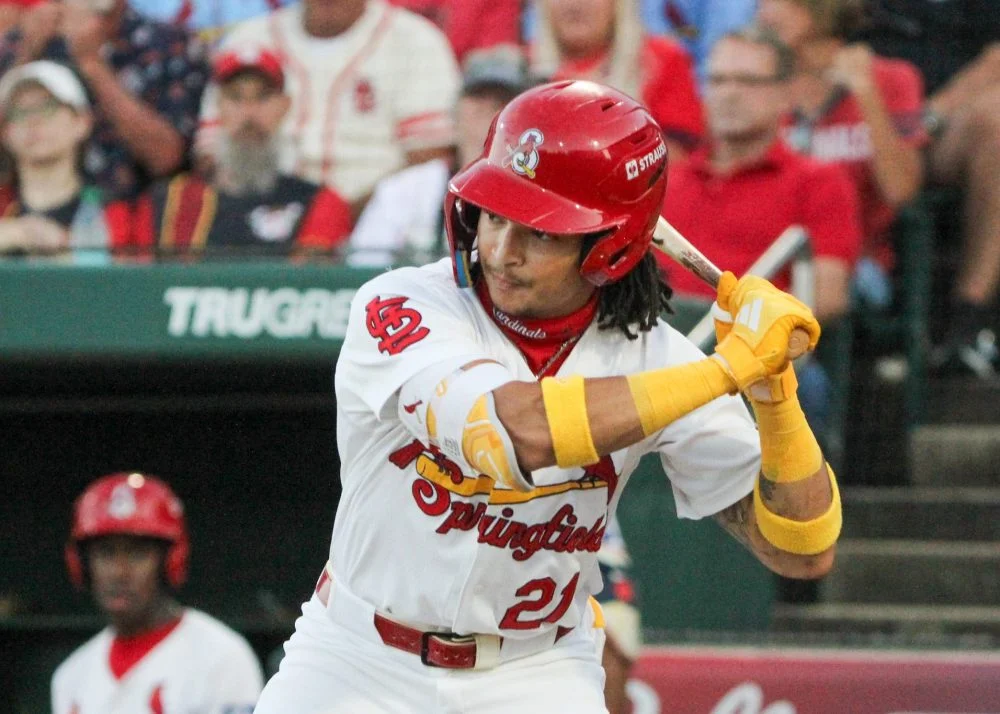
Peete’s recent production follows a late-May illness that cost him nearly two and a half months and some of his physicality. After returning, he hit across three levels and played high-quality defense in the outfield. In one Fall League week, he went 6-for-9 with four runs, three doubles, two triples, an RBI, a walk and three stolen bases. That burst combined extra-base impact with baserunning and patience, though a single week can only offer a snapshot.
The interruption gives the production added context. Missing that much time can complicate a player’s season: there’s the work of getting back into playing shape, then the challenge of regaining timing against live pitching. The source describes Peete as having lost some physicality, so his return across three levels suggests he had to rebuild while continuing to face different competition. It doesn’t establish exactly how much of his earlier form he recovered, but it makes the Fall League opportunity more than a routine extension of the season.
For an outfielder, the defensive note also matters. A potential center fielder has to contribute beyond the plate, and the source says Peete played high-quality defense after returning. That’s encouraging, though it doesn’t provide detail on his range, arm, or specific plays. The distinction is useful: the report gives a positive assessment of his overall outfield work, while leaving open how his defense would translate to a full season in center.
What the numbers can and can’t tell St. Louis
Peete’s .341/.426/.634 start points to frequent success reaching base and substantial extra-base production. The line is strong enough to make him an early standout, as the source describes him, and the week of doubles and triples gives that impression some texture. Still, the Fall League sample is limited. A short run can show what a player is doing now; it can’t by itself establish what he’ll do over a full season.
That’s why the broader record in the source carries weight. Peete returned from an extended absence and hit across three levels, while also contributing defensively. Taken together, those details provide a fuller view than the Fall League line alone: the question is not only whether he can run up numbers in a brief stretch, but whether he can sustain his progress after a disrupted year. This is more significant than it looks, though the evidence remains early.
If you’re following St. Louis’ outfield plans, the center-field possibility is the clearest reason to keep watching. The source frames it as a conversation Peete could enter if this level holds into 2027, not as a job already within reach. That’s a measured distinction. The Fall League can give the club another look at him, but the article doesn’t identify other candidates or explain how the Cardinals will make that decision.
There’s also a practical limit to what the available details establish. We know Peete’s line through 10 games and his production in one week; we don’t have a longer Fall League record here. We know he played high-quality outfield defense after returning, but not a breakdown by position. A signal, then. Not a verdict.
Lamkin’s return adds a pitching counterpart
Justin Lamkin offered a strong counterpart on the pitching side. The Kansas City Royals left-hander, pitching for Surprise, worked 4⅓ hitless innings without a walk or earned run and struck out four. The outing is a clean result: he kept opposing hitters from recording a hit, avoided walks, and finished with four strikeouts. It’s a promising appearance, but one outing doesn’t settle questions about a pitcher’s longer-term health or role.
Viewed as a high-floor starter after leaving Texas A&M in 2025, Lamkin appeared poised to move quickly through the minors before a shoulder issue ended his season in late May. He’s healthy again and using the offseason to broaden his mix, including the addition of another breaking ball. That sequence makes his Fall League work relevant in two ways: it offers a chance to pitch again after an injury-shortened season, and it comes as he’s working to add another option to his repertoire.
For a starter, a broader mix can give him more ways to approach hitters, depending on how the pitches develop and how well he commands them. The source doesn’t specify what the new breaking ball looks like or how often he’ll use it, so the outing shouldn’t be treated as proof that the change has already succeeded. What it does show is a healthy return to game action with an efficient result across 4⅓ innings.
The next stretch will matter more than the first impression
Peete and Lamkin arrive at this point with different questions. Peete is building on a return from illness and putting his bat and outfield defense back in view; Lamkin is pitching again after a shoulder issue and expanding his mix. In both cases, the Fall League gives teams another chance to observe players after a disrupted season. The setting can make progress visible, but the next stretch is what will show whether these early signs persist.
The Minor League Update is covering the playoff stretch as the minor league season winds down, then will return during the winter leagues. Peete’s early Fall League run gives St. Louis a particularly useful signal to track as the next season approaches. For readers, the key is to treat that signal as a reason to follow his development, not as a forecast already fulfilled. And yet, after an illness cost him nearly two and a half months, a productive return across three levels followed by this start is a meaningful change in the story of his season.
Discussion
Sign in to join the discussion.