A significant shift in MLB talent sourcing from Japan is underway, led by metrics-driven evaluations and a rising generation of players.
Traducido por José M. Hernández Lagunes
MLB has historically benefitted from Japanese talent, particularly during dominant phases led by household names. Today, however, a noticeable shift is occurring in how MLB teams approach recruiting players from Japan. The current wave, highlighted by Shohei Ohtani and accompanied by promising recruits such as Yusei Kikuchi and Yoshinobu Yamamoto, suggests a more sustainable model for scouting and development.
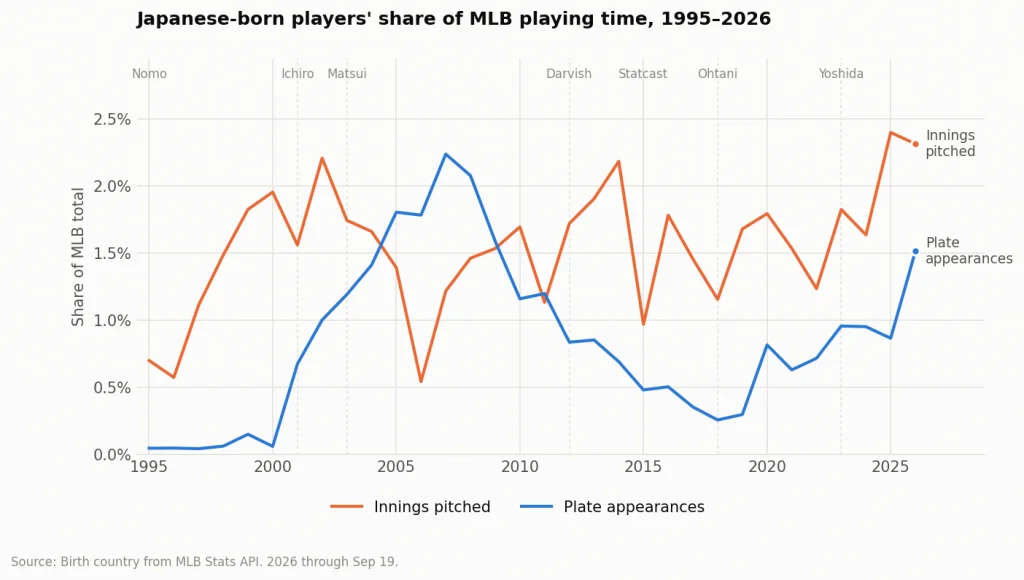
Japan's first MLB player, Masanori Murakami, set the stage in 1964, but significant waves of talent typically spurred by stars emerged after the new millennium. Ichiro Suzuki spearheaded a golden era, joined by players like Daisuke Matsuzaka and Koji Uehara, who shaped perceptions of Japanese talent in the league. Although interest waned after a second surge led by pitchers like Yu Darvish, the current dynamics reveal a different story.
MLB teams are not merely following trends; they're adapting fundamentally how they assess talent from Japan. Unlike previous scouting strategies emphasizing overall statistics, teams now focus on intricate performance metrics that reflect a player's pure abilities. The emphasis on process metrics like exit velocity and pitch type has become paramount. These statistics transcend the variability associated with traditional performance indicators such as ERA or OPS, giving teams clearer insights into players’ skills.
For instance, a pitcher's fastball velocity, while it may fluctuate slightly based on stadium conditions, is largely a function of their innate physical capabilities. This focus on objective, quantifiable data enables teams to project potential success as these metrics have shown to correlate well across different playing environments.
In a shift that aligns closely with advancements in data analytics, teams are recognizing that metrics collected during events like the World Baseball Classic often serve as more reliable indicators of future performance than traditional statistics derived from full seasons. Notably, data from PitchF/X and Statcast has reshaped talent evaluation, allowing teams to catch a glimpse of player potential from even limited sample sizes.
For example, the correlation between launch angle and exit velocity among players can deliver insights consistent with MLB performances. This reliance on measurable performance attributes has become a game-changer in evaluating Japanese talent, indicating a movement toward more strategic, data-informed recruitment methodologies.
Efforts to recruit at a younger age are also apparent, with emerging prospects like Rikuu Nishida opting to play college baseball in the U.S. before establishing themselves in Japan's Nippon Professional Baseball (NPB). These athletes provide an additional avenue for MLB to access raw, high-quality talent while allowing teams to gather valuable data on individual player capabilities. The adjusting recruitment strategies reflect an evolving understanding of player development and talent acquisition.
The upshot of this shift shows there are more Japanese players now in the minor leagues than ever before, indicating a growing pipeline. This trend is positive, but it’s also premature to declare a permanent dominance in MLB given that prior international prospects have struggled to maintain their presence after early promise.
So far, the impact of these younger Japanese players in MLB has been limited, with few exceptions seeing significant playing time. Nonetheless, continuous investments in scouting and the integration of data analytics could very well cultivate a steady stream of talent that strengthens MLB rosters long-term.
Ultimately, whether this new generation of Japanese players becomes a lasting presence in the MLB remains to be seen. The transition from sporadic waves of talent to a consistent inflow shows promise and aligns with shifts in how teams evaluate athletes. As teams continue to hone their scouting methodologies, they might find that tapping into Japan's baseball scene yields considerably more than just occasional stars.
As the future unfolds, understanding the evolution of talent recruitment tactics will be essential in assessing the league’s trajectory concerning international player diversity and contribution. The dynamics at play signify a shift in paradigms that could reshape the landscape of MLB recruitment for years to come.
The post Esta ola de talento japonés es el principio de un canal de alimentación appeared first on Baseball Prospectus.
Discussion
Sign in to join the discussion.