A prized rookie card shares space with Nolan Ryan, but Jerry Koosman’s early success and 1969 World Series heroics deserve their own spotlight.

Jerry Koosman’s 1968 rookie card is valuable largely because it shares the frame with Nolan Ryan. A mint copy can fetch $100,000, while one in excellent condition can still command a steep price. That gap between the card’s plain design and its market price tells you what collectors are paying for: condition, scarcity, and the presence of a future star. The design offers little beyond two headshots against a faux burlap border, but the names on the card tell a more interesting story. At the time, Koosman was already the more accomplished pitcher.
Before Ryan became the headline
Ryan’s later fame reshaped how collectors remember that card. It’s easy to look backward from his eventual reputation and assume the pairing was obvious from the start. But for fans watching the 1968 season, Koosman had the stronger case. Both pitchers joined the Miracle Mets, yet Ryan was an unreliable swingman who walked 14% of the batters he faced—one of his better rates. Koosman made the All-Star team in each of his first two seasons and won two of New York’s five World Series games in 1969.
Those facts don’t make Ryan’s later career less remarkable. They do show how quickly a career’s eventual shape can overwrite its beginning. A rookie card freezes two players at one moment, while its reputation keeps changing as their careers unfold. In this case, Ryan’s later stature turned a shared card into a prized piece of his story, even though Koosman had done more to establish himself at the time.
For collectors, the names are only part of the calculation. Condition can sharply affect a card’s value, and the contrast between a mint copy and one in excellent condition signals how closely buyers attend to preservation. The card’s modest artwork offers little visual drama; its appeal comes from the historical connection and the careers compressed into a small rectangle.
The start that defined Koosman’s place in the story
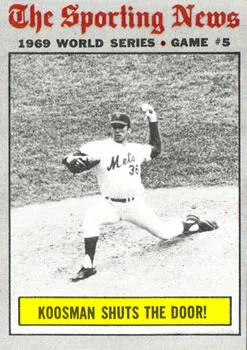
His final start of that Series supplied the scene that sticks. Koosman fell behind the Orioles 3-0, then allowed just one hit the rest of the way. When the game ended, he leaped into catcher Jerry Grote’s arms. A game can be remembered through a score, but that image gives the performance a human scale: a pitcher recovering from a difficult start, finishing the job, and sharing the moment with his catcher.
A moment that resists easy retelling
The Miracle Mets’ triumph came soon after Joe Namath and the New York Jets won Super Bowl III, giving the era the feel of an improbable sports sequel. The familiar ingredients were there: an underdog, a cast of memorable characters, and a run of events so unlikely it could seem almost scripted. That very improbability made the victory glorious—and, with time, easy to file away as a quaint baseball story.
But the label “Miracle” can flatten the work behind a championship. The story’s improbable shape is memorable; the pitching, pressure, and individual performances that made it possible are easier to lose in the retelling. Koosman’s comeback within that final start is a reminder that the Mets’ achievement wasn’t only a tidy underdog narrative. It was also a sequence of games decided by players doing specific, difficult things.
Yet the players and the moment remain close enough to touch. Fifty-seven years later, members of that team are still here, while a black-and-white newsprint image preserves Koosman’s World Series win. The contrast is striking: a rookie card prized for the star beside him, and a pitcher whose own defining performance helped make the Mets’ story real.
What the card leaves out
Ryan became a legend, and the card’s market value reflects that. Koosman’s case rests elsewhere—in early All-Star seasons and a World Series performance that deserves to be remembered on its own. This is more significant than it looks: the card captures a moment before the familiar hierarchy had settled, when the less celebrated name had the stronger record to point to.
That said, a collectible can’t carry the whole history of either player. Its price reflects what buyers value now, while the season’s context asks a different question: who mattered most to the Mets then? If you’re working in this space, that distinction is useful. A card can be a record of shared beginnings and a lesson in how hindsight edits them (and this is the part most people overlook). Ryan’s fame explains the premium. Koosman’s performance explains why the card’s story is richer than the premium alone.
For a moment, before the later careers changed the frame. And yet.
Discussion
Sign in to join the discussion.