Jordan Walker paired elite contact quality with 22 steals in 2026. His strikeout rate, home park and rising draft cost will shape his fantasy value.
Jordan Walker turned a late fantasy pick into a top 10 dollar-value player in 2026, according to FanGraphs’ Player Rater. That return came after two seasons of poor results and a spring that offered little reassurance. The case for his breakout rested on a simpler point: the power never disappeared, and changes to his swing helped him use it with more confidence.
Power was there before the results
Walker’s 2024 and 2025 seasons with the St. Louis Cardinals gave fantasy managers plenty of reasons to hesitate. Across 162 games, he hit .211/.270/.324 and struck out 30.7% of the time. The Cardinals sent him to Triple-A Memphis in both seasons to reset and work on his swing, but the minor league results were uneven, and his struggles continued after he returned to the majors.
His contact still carried unusual force. In 2025, Walker ranked in the 87th percentile for hard-hit rate, the 66th for barrel rate and the 91st for average exit velocity. The problem was making contact often enough to turn that quality into production. His strikeout rate climbed to a career-worst 31.8%, while a 47.5% ground-ball rate and an 11.3% rate of pulled fly balls limited his ability to translate raw power into home runs.
That mix made Walker a difficult draft bet. His quality of contact suggested a hitter with significant upside; his swing decisions and contact rate suggested that upside might remain out of reach. His average draft position across NFBC leagues was 359.2, a price that reflected both the talent and the uncertainty.
A mechanical adjustment needed time
Walker spent the previous offseason working at Driveline Baseball, focusing on keeping his right hip back so he could stay balanced and retain more of his natural power. The work didn’t produce an immediate spring training turnaround. He went 6-for-28, without an extra-base hit, across his first 10 Grapefruit League games, and recorded two walks against 11 strikeouts.
The Cardinals then held him out for three days so he could work in the batting cages. Manager Óliver Mármol continued to back him, pointing to the care Walker was putting into his preparation. “We’re excited about the work he’s doing, the attention to detail, and that hasn’t changed,” Mármol told SI.com. “You stay focused on those things because, eventually, they’re what will get him where he needs to go.”
Walker reached base four times and hit a home run in his final two spring games. He carried that better finish into the regular season, posting a 1.116 OPS with eight home runs over his first 16 games. By the end of May, he was hitting .290/.357/.551 with 15 home runs, 43 RBIs and a 24.4% strikeout rate.
Walker and Mármol both credited better communication between the hitter and the dugout. Walker said the team could use data on his body movement to identify when he felt comfortable at the plate and when he didn’t. “When I see the data, I can talk about it, and then we can try to speak in their terms,” he explained during the final week of the season in an interview with MLB.com. That process looks like part of the story: the numbers gave Walker and the staff a shared way to discuss adjustments as he worked through the season.
Contact, speed and a memorable Derby
Walker’s most public moment came in July, when he rallied to beat Kyle Schwarber in the Home Run Derby final at Schwarber’s home park. A dip in Walker’s production during the second half prompted talk that the competition had taken a toll. His August numbers complicate that theory: he hit .305/.348/.505 with five home runs. Research on the supposed Home Run Derby “curse” has also found little support for the idea that the event reliably harms players afterward.
September was the genuine slump. Walker hit .172/.232/.287 with two home runs and a 36.8% strikeout rate. The Cardinals later disclosed that he was dealing with hip discomfort late in the season, a plausible factor in the decline. The workload may have mattered, too: 2026 was his first full major league season, and opposing pitchers had spent the year adjusting to him as a central part of the lineup.
The season’s broader contact data helps explain why the breakout held up. Walker’s ground-ball rate fell to 42.8%, below the league average for the first time, while his pulled-fly-ball rate rose to 15.9%. Those changes didn’t turn him into a classic fly-ball hitter, but they gave his exceptional contact more chances to produce damage. He finished in at least the 90th percentile in hard-hit rate (49.9%), barrel rate (13.2%) and average exit velocity (92.6 mph).
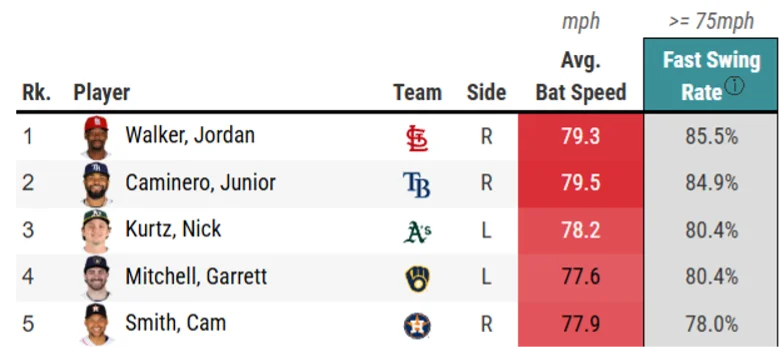
His swing speed was another outlier. Walker averaged 79.3 mph, second in the majors behind Junior Caminero. His fast-swing rate—the share of swings reaching at least 75 mph—led the league, as shown in the Baseball Savant image below.
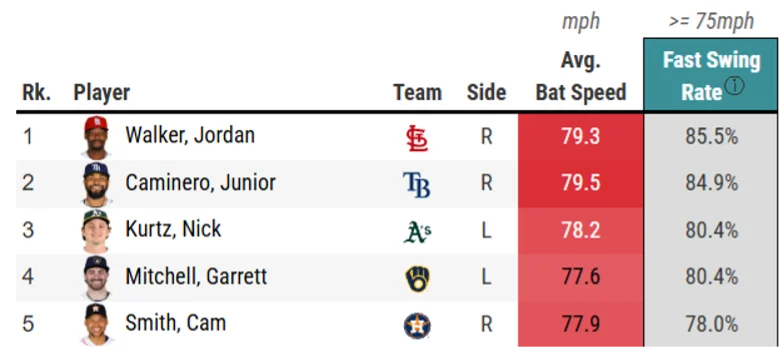
From 2024 through 2025, 76.2% of Walker’s swings reached that threshold. In 2026, the rate climbed to 85.5%. That’s a substantial change, and it fits the broader impression that he became more comfortable letting his swing go. His strikeout rate still needs attention, but the improved contact profile gives the power a stronger foundation.
Walker added value on the bases, too. He stole 22 bases and was caught five times. He finished one home run short of joining a group of just five players with at least 30 home runs and 20 steals. At 6-foot-6 and 250 pounds, he’s an imposing figure, but he has always been quick; his sprint speed ranked in the 91st percentile in 2026. Getting on base more often gave him more opportunities to use that speed.
What his next draft price should reflect
Busch Stadium III remains a meaningful headwind for Walker’s home run totals. Over the past three seasons, only Pittsburgh’s PNC Park has been a tougher venue for right-handed hitters to homer in. Walker hit 19 home runs on the road and 10 at home in 2026, a split that makes the park’s effect difficult to ignore.
The lineup around him offers less certainty. St. Louis’ offense performed better than some expected but still ranked in the bottom third of the majors with a 93 wRC+. The organization is unlikely to be a major player in free agency this winter, so Walker may continue to receive limited support. Still, the weaker lineup didn’t prevent him from building strong counting stats this season.
The larger lesson is to leave room for former top prospects to develop, especially when they’re young and still hitting the ball hard. Walker will turn 25 in May. His 2026 performance will push him into a much higher draft tier, so the value of a pick near 359.2 is gone. My read is that he’ll remain worth considering at a premium price, provided his strikeout rate stays in the 20s rather than returning to the 30s. The power and speed are now established parts of the profile; the next test is whether he can keep making enough contact to sustain them.
Discussion
Sign in to join the discussion.