A replay overturns Cooper Pratt’s apparent final out, but Trevor Megill strikes out Johnny DeLuca to secure Milwaukee’s win.
A celebration interrupted
Milwaukee’s celebration stopped with one out to go. A replay review put the tying run on third, sent the players back to their positions and left closer Trevor Megill to finish the job with the World Series suddenly alive again. The sequence turned a finish that seemed settled into a live contest, with every player and spectator forced to reset in the middle of the moment.
The turning point came on a throw from Brice Turang to first baseman Jake Bauers. Cooper Pratt appeared to be out, and Bauers had the ball in his mitt with room to spare. But Tampa Bay manager Kevin Cash challenged the call. Replay showed Pratt’s right cleat sliding off the bag as he received the throw, and the out was overturned.
It’s the sort of distinction that can be difficult to see at game speed. A fielder can appear to complete a play cleanly while a runner’s contact with the base changes the ruling under review. In baseball, the visual impression of an out and the evidence available on replay don’t always match. Here, the detail was small; its effect was not.
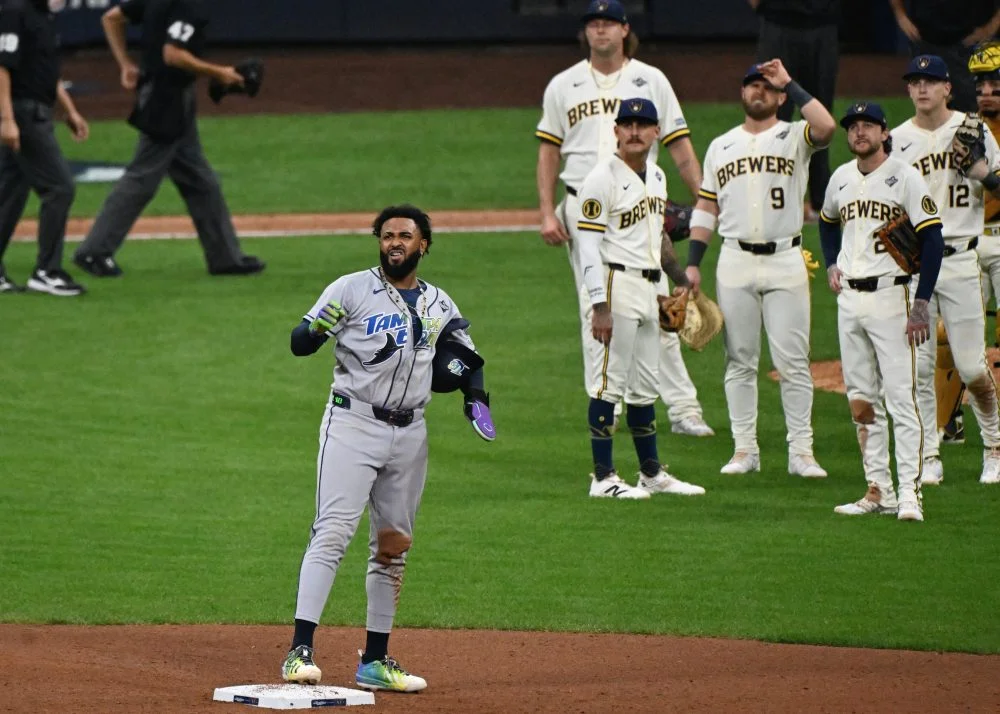
For a moment, the scene at American Family Field seemed suspended: fireworks smoke above the field, Pratt staring at himself on the center-field screen, and Milwaukee fans forced to sit back down after beginning to celebrate. The review erased what looked like the final out and gave Tampa Bay another chance, with the tying run at third and the winning run 90 feet behind.
That was a sharp change in the terms of the moment. A team expecting to leave the field had to return to its defensive positions, while the team that had seemed finished suddenly had a runner close enough to score on a single, a sacrifice fly, or a mistake. Those possibilities aren’t guarantees, of course. They’re the pressure contained in the setup.
Two teams forced to reset
The delay left both teams with a strange task. The Brewers had to recover from a celebration abruptly cut short; the Rays had to make something of an opportunity that arrived after the game had appeared settled. Chandler Simpson had already scored the tying run on the double-play ball. Johnny DeLuca now stood between Milwaukee and the win.
For Milwaukee, the challenge was mental as much as tactical. Players don’t get to choose when a game’s emotional peak arrives, and a reversal can leave a club trying to move from relief back into concentration in seconds. The crowd’s reaction adds another layer: noise and movement that had signaled an ending now accompany a game that’s still going.
Tampa Bay faced a different kind of burden. The overturned call gave the Rays life, but it also made the remaining opportunity unusually clear. With the tying run already home and another runner at third, DeLuca needed only to extend the game or drive in the winning run. The opening was real. So was the pressure to use it.
Here’s the thing: replay didn’t decide the game by itself. It restored a chance that the original call had removed, then handed the next decision to the players. The review made the finish longer and more tense, but it couldn’t tell DeLuca what pitch was coming or Megill how to throw it.
(And this is the part most people overlook.) A replay reversal can change the score situation without changing the basic job in front of the pitcher: get the next hitter out. That sounds simple until the crowd has started celebrating, the opponent has been given another life, and the championship is one pitch away from continuing.
Megill finds the final out
Megill threw several fastballs high as he tried to regain his rhythm. On the fifth pitch, he dropped a knuckle curve into the dirt. DeLuca swung weakly and missed, ending the game. Megill roared; Pratt, whose misstep had reopened the contest, let out a tired shrug and sigh.
The sequence was untidy, which is part of what made the finish memorable. Megill didn’t immediately settle the at-bat with a crisp pitch. He missed high, then returned with a breaking ball low enough to draw a swing that couldn’t make contact. The final result was decisive, even if the route there wasn’t.
For a closer, the emotional task is to keep throwing after the game has appeared to end. The replay review gave Megill time to wait, but waiting isn’t the same as being ready. He had to return to the mound with the pressure reset around him, while DeLuca had the chance to turn one plate appearance into a continuation of the series.
A swing and miss ended that possibility. Megill’s reaction said plenty about the release of tension, while Pratt’s shrug captured the strange position of having played a part in reopening the game and then watching his teammate close it. One pitch resolved what the overturned call had left uncertain.
What the finish means
The Brewers had to earn the final out twice, and the second attempt carried the weight of the first. Milwaukee’s win was its first in a World Series game in 44 years. Replay had turned a routine-looking finish into a test of composure, and Megill supplied the answer when the celebration had to wait.
This is more significant than it looks. The call didn’t change the entire game, but it changed the last scene: who had the advantage, where the tying run stood, and whether Milwaukee could begin celebrating. That’s a reminder of how a close play can outweigh its modest appearance. A cleat coming off a base can matter more than a throw that seems comfortably in time.
For anyone watching the sport, the episode also shows the limits of certainty in a finish. Fans may see the ball arrive and assume the play is over; players may react the same way. Yet the runner’s contact with the bag remains part of the play, even when the crowd has already begun to respond to an apparent ending.
If you’re working in this space, the useful point is that replay’s impact is both procedural and human. The review corrected the call, then forced two clubs to manage an abrupt emotional shift. That second effect can’t be captured by the ruling alone, but it shaped the conditions under which the last pitch was thrown.
And yet, the game still came down to execution. Tampa Bay got another chance; Milwaukee’s closer got another hitter. DeLuca swung through the curve, Megill finished the job, and the delayed celebration could resume.
One more pitch. One more out.
Discussion
Sign in to join the discussion.