Tampa Bay turns to Nick Martinez against Milwaukee’s Jacob Misiorowski, setting up a sharp contrast in pitching style and postseason form.
Tampa Bay’s choice of Nick Martinez for Game 1 gives the World Series an unusual opening matchup: a veteran who works through command and contact against Jacob Misiorowski, whose defining weapon is a fastball that can reach 104 mph. The Rays may be accepting a less imposing start tonight to strengthen their pitching options over the next several games. Milwaukee, meanwhile, gets a chance to see whether its young ace can recover his regular-season bite against a lineup that struggled badly with elite velocity.
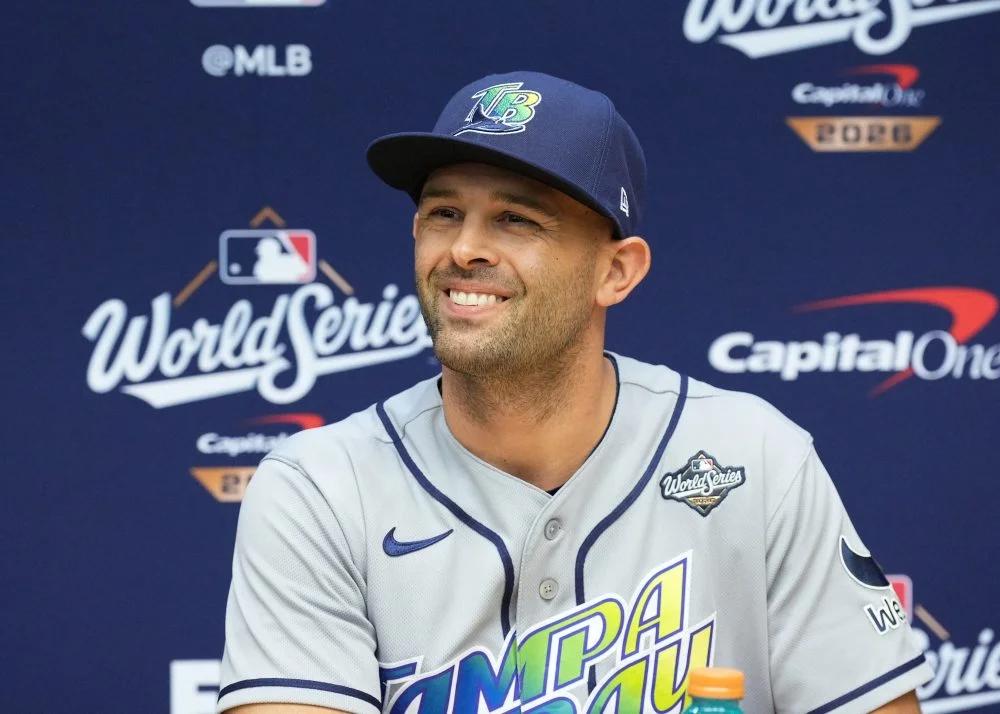
A deliberate choice by Tampa Bay
Tampa Bay Rays (1) at Milwaukee Brewers (1), 8:00 PM ET
TB: Nick Martinez (15-6, 3.10 ERA, 116 DRA-)
MIL: Jacob Misiorowski (16-5, 1.80 ERA, 59 DRA-)
The Rays had been expected to start Drew Rasmussen before switching to Martinez. It’s a choice that makes more sense across the series than in isolation: Tampa Bay appears to be positioning itself for an advantage in Games 2 through 4, while keeping its bullpen available for an aggressive approach in the opener. Kevin Cash has a rested relief corps, and the Rays’ ace is lined up for Game 2, followed by a day off.
Still, the decision makes the first game less straightforward. Martinez had the best results of his career in 2026, earning his first All-Star selection and setting a personal high for innings. But his underlying profile is less dominant than those headline numbers suggest. He strikes out few hitters and allows plenty of fly balls, a combination that usually leaves little margin for error. His record over a decade and a half as a professional suggests that his success isn’t simply a short-lived run of good fortune.
Martinez’s game depends on precision. He moves among three fastball variations, works all four quadrants of the strike zone and uses a changeup that pairs effectively with his other pitches. His priority is to keep hitters from making clean contact, rather than overpowering them. The radar gun tells the story: if Martinez reaches 94 mph, he’s likely running hot.
Milwaukee’s patience meets Martinez’s strike-throwing
The tactical tension is clear. Milwaukee was unusually reluctant to swing in 2026, recording the lowest overall swing rate in the majors and the second-lowest rate on pitches inside the strike zone. Martinez, by contrast, is willing to challenge hitters with strikes and trust his command to produce weak contact.
That combination leaves the Brewers with a choice. They can stick to their patient approach and try to draw Martinez into deeper counts, or attack earlier when he offers a pitch in the zone. The first innings should show whether Milwaukee’s hitters are prepared to let the Rays starter establish his rhythm. Tampa Bay’s short leash may also change the calculation: if Martinez starts to lose control of the matchup, Cash has reason to move quickly to his bullpen.
Martinez’s low strikeout rate makes that sequence worth watching. The Brewers don’t need to chase pitches outside the zone to make him work, but passing up strikes could put them behind in counts and let him dictate the at-bat. The matchup will test whether Milwaukee can preserve its discipline while still making enough contact to put pressure on a pitcher whose approach relies on hitters failing to square the ball.
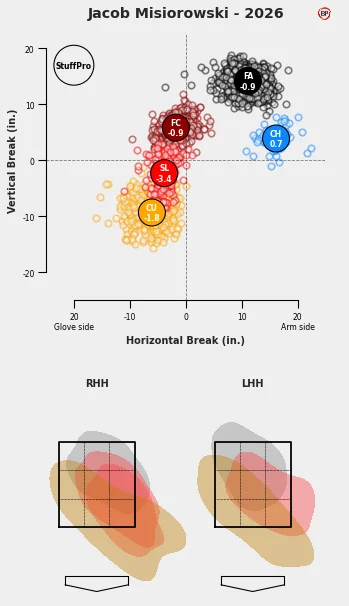
Misiorowski’s October fastball question
Misiorowski’s regular-season case was built on extraordinary results per inning and one of the most imposing fastballs in the sport. His four-seamer produced a 40.2% whiff rate during the season. The postseason version has been harder to recognize: in two starts, he hasn’t made it beyond the fifth inning, and opponents have extended at-bats enough to raise his pitch count.
His October numbers aren’t disastrous. Misiorowski has allowed three runs in 8⅓ innings. But that’s a more ordinary level of performance than his regular-season dominance promised, especially for a pitcher whose velocity and strikeout ability can overwhelm hitters. The four-seamer’s whiff rate has fallen to 16.1% in the postseason, a steep drop from the summer mark.
He’s continued to rely heavily on the pitch. Misiorowski threw his fastball 63% of the time in the regular season and has kept using it through both postseason starts. He can reach triple digits and still has plenty of velocity when he settles down, but his hardest pitches often arrive early. In the first inning, he has shown a tendency to fire 102-to-104 mph fastballs before gradually losing a few ticks by the third or fourth.
That pattern means hitters may see Misiorowski at his most explosive the first time through the order. On a second look, they’re still facing a fastball-heavy plan, but one delivered at a relative speed advantage that has narrowed. Fatigue is another possible factor: he has already exceeded his previous career high in innings by more than 50. Yet the early velocity spike also appeared during the regular season, so it isn’t solely an October development.
The matchup that could decide the opener
The question is whether Misiorowski adjusts. He could vary his pitch selection or find more consistent strikes with his secondary offerings, which have been difficult for him to land this postseason. But changing a plan built around his fastball carries its own risk, particularly against Tampa Bay.
The Rays were baseball’s weakest team against four-seam fastballs at 98 mph or harder in 2026. They posted a .206 wOBA against that velocity and hit only two home runs. That makes the matchup unusually favorable for Misiorowski’s most direct route back to dominance: challenge Tampa Bay with the pitch that has carried him all season.
There’s a strategic tension on both sides. The Rays have selected a starter whose control and weak-contact approach could clash with Milwaukee’s reluctance to swing, while saving resources for the games that follow. The Brewers have a pitcher whose postseason results have softened, but whose fastball still targets the area where Tampa Bay has been most vulnerable.
Game 1 may come down to which team gets to impose its preferred pace. If Milwaukee makes Martinez throw strikes under pressure, Tampa Bay could turn to its bullpen early. If the Rays can force Misiorowski into longer at-bats and make his fastball less effective, his velocity advantage may not last long enough to define the night. The opening matchup is less a simple contest between veteran and fireballer than a test of whether each pitcher can make his best approach work against a lineup built to challenge it.
Discussion
Sign in to join the discussion.