The 100-win Dodgers fell to Milwaukee in four games, a reminder that playoff results can turn on health, form and a short run of baseball.
The Los Angeles Dodgers entered the 2026 season with the cast and budget of a baseball villain: a deep roster, major stars and expectations of a third straight championship. They left the National League Championship Series swept in four games by Milwaukee, a small-market club that had posted the league’s best record. The gap between those expectations and the result is striking. The result itself, though, isn’t proof that the Dodgers’ season-long strengths disappeared.
The sweep makes for a clean postseason story, but clean stories can flatten the details. A team can dominate over a long season and still lose when a brief series turns on a few cold bats, missed chances or timely plays by its opponent. That doesn’t make the defeat meaningless. It does mean the final scoreline can’t carry every argument about how good the Dodgers were, or what their resources bought them.
Money, expectations and the villain role
Los Angeles was an easy target in the debate over money and competitive balance. PECOTA projected the Dodgers to finish with baseball’s best record, and their payroll and star power made them a natural foil. Instead, Milwaukee took that distinction, then eliminated Los Angeles before the series could reach a fifth game.
That reversal gives the Brewers a satisfying underdog role, though the label can obscure what they accomplished. They had the league’s best record, and their sweep showed that their regular-season standing wasn’t a footnote to the Dodgers’ story. Los Angeles entered with the attention and expectations; Milwaukee left with the result.
The team’s roster also complicated the villain story. Players such as Kiké Hernández, Shohei Ohtani, Freddie Freeman and Yoshinobu Yamamoto gave the Dodgers a likable presence, even as the club’s resources made it a ready-made antagonist. A team’s public image rarely maps neatly onto its players: star power can attract fans while the spending behind that star power fuels resentment. Baseball supplied a sharper ending than the season’s setup suggested.
Four games can’t explain a 100-win season
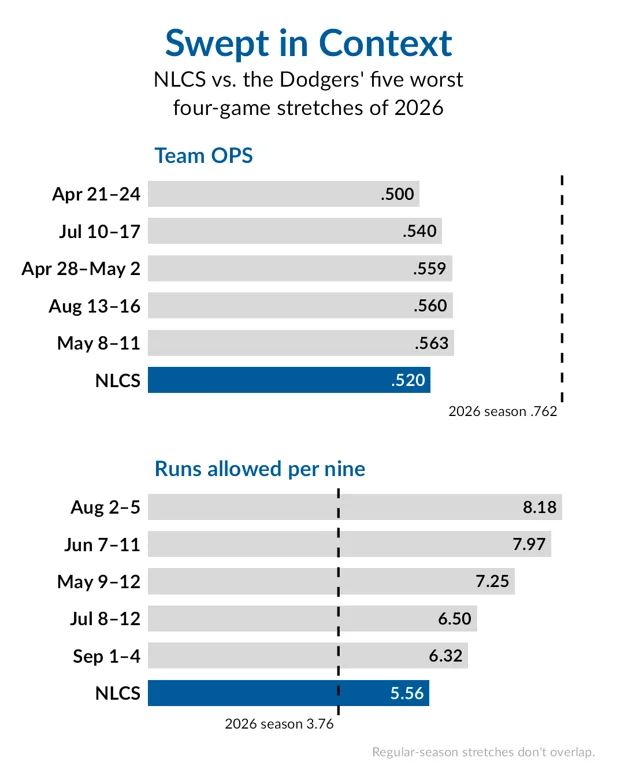
The Dodgers managed a .520 OPS against Milwaukee, an ugly figure for an offense built around elite talent. But a four-game stretch is a narrow sample, and the club had already endured comparable slumps during the regular season. In an April run against the struggling San Francisco Giants and the Cubs, Los Angeles posted a .500 OPS and scored two runs per game.
That comparison doesn’t excuse the NLCS offense. It shows that a lineup’s worst stretch can look startlingly different from its typical performance, even when the players and team are the same. Over a full season, strong stretches and weak stretches accumulate; in a short series, the weak stretch may be all anyone sees. The Dodgers didn’t have enough time to let their broader record answer back.
The pitching and defense also had stretches worse than the 5.56 runs allowed per nine innings against Milwaukee. That doesn’t make the NLCS performance irrelevant: the Brewers exposed the Dodgers’ weaknesses and made the most of their opportunities. It does put the sweep in context. A short series can reveal problems without establishing that those problems defined the team all year.
Here’s the thing: the Dodgers’ strengths were real, and so were the failures Milwaukee forced into view. Treating one as an illusion because of the other makes for a less useful account. The numbers here are underwhelming, but they describe what happened in those games; they don’t, by themselves, explain every cause or settle the question of the team’s overall quality.
That uncertainty is part of October baseball. Teams need large samples to show their underlying level consistently, but a playoff series offers little room for correction. Health and timing matter, too. The Dodgers weren’t healthy enough or hot enough when it counted, while Milwaukee’s approach and execution carried it through four games. And yet, a team’s inability to recover within a series is part of what the format tests.
The ending doesn’t erase the season
Los Angeles’s 100 wins bought no protection once the postseason began. Regular-season dominance can make a team feel destined to advance, but it can’t guarantee that its best players will be healthy, productive or decisive in a short series. The Dodgers’ offense stalled, their run prevention faltered, and the Brewers moved on.
This is more significant than it looks for anyone reading the result as a verdict on spending: a large payroll can help build depth and star power, but it can’t make a short series predictable. That’s a limit on what resources can deliver, not proof that resources don’t matter. If you’re working in this space, the useful distinction is between improving a team’s chances over time and guaranteeing a specific October outcome. The latter isn’t what a season’s record can promise.
There’s a temptation to turn that outcome into a sweeping judgment about the Dodgers or the sport’s financial balance. The more useful read is narrower: even a heavily favored team can be undone by a bad four-game stretch, especially against an opponent playing well. The Dodgers’ season ended abruptly, and their next chance to shape the story will come when baseball starts again.
What the sweep leaves unresolved
The sweep settles who advanced; it doesn’t settle whether the Dodgers’ roster was built well, whether Milwaukee’s result reflects a lasting advantage, or how much the payroll gap mattered in this particular matchup. Those questions need evidence beyond the series outcome. A four-game result can support scrutiny, but it can’t carry every conclusion that fans or critics may want to attach to it.
That said, October still matters precisely because it can overturn the expectations built across months. For Milwaukee, the win validates the season’s best record with a direct result against a major favorite. For Los Angeles, the loss is a reminder that talent and preparation leave room for bad timing, uneven health and an opponent that executes better. The fragment that matters: a season’s standing is earned over time, while a championship path can close in four games.
The next season will give the Dodgers another opportunity, but it won’t retroactively soften this ending. Their 100 wins remain part of the record; so does the sweep. Keeping both facts in view is a more precise way to understand the season than treating either one as the whole story.
Discussion
Sign in to join the discussion.